
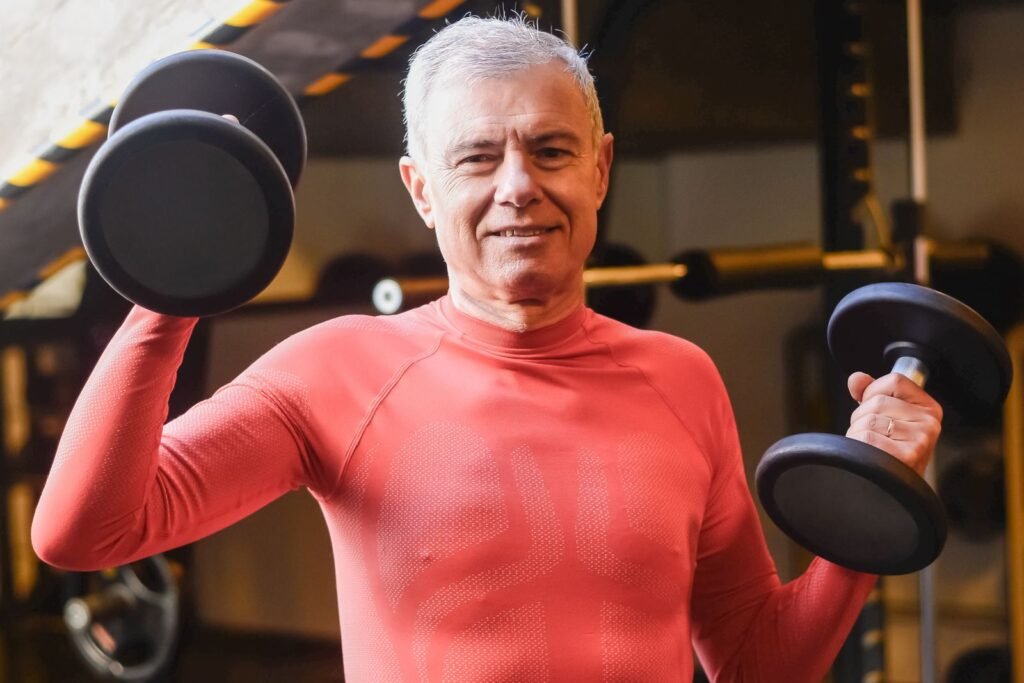
For decades, longevity research focused on the obvious suspects: blood pressure, cholesterol, smoking, body weight. Muscle was treated as cosmetic, something for athletes and bodybuilders. That view has collapsed. Over the past fifteen years, muscle mass and, even more strongly, muscle strength have emerged as some of the most reliable predictors of how long men live and how well they function in their final decades. The relationship holds after adjusting for age, weight, and existing disease, and it is large enough that some researchers now argue muscle should be treated as an organ of longevity in its own right.
This guide explains what the research shows, why muscle protects lifespan through several distinct mechanisms, how much muscle matters, and what to do about it at any age.
What the Research Shows
Several large studies have tracked muscle mass and strength against mortality over many years. The pattern is consistent. In an analysis of over 3,600 older adults from the National Health and Nutrition Examination Survey, those in the highest quartile of muscle mass had substantially lower all-cause mortality than those in the lowest, independent of body fat. A 2018 study in the BMJ following nearly half a million UK Biobank participants found that lower grip strength, a proxy for whole-body strength, was associated with higher all-cause and cardiovascular mortality, cancer incidence, and cancer mortality.
Strength appears to matter even more than mass. Men with low muscle mass but preserved strength fare better than men with adequate mass but poor strength, which suggests that what muscle can do (contract forcefully, stabilise joints, clear glucose) matters more than how much of it there is. The practical implication is that training for strength, not just size, is what moves the longevity needle.
Why Muscle Protects Lifespan
| Mechanism | How it extends healthspan |
|---|---|
| Metabolic reserve | Muscle is the main site of glucose disposal; more of it means better insulin sensitivity and lower type 2 diabetes risk |
| Fall and fracture protection | Strength and balance prevent the falls that trigger rapid decline in older men |
| Surviving illness | Muscle is the body’s protein reserve during serious illness, surgery, or hospitalisation; low muscle predicts worse outcomes |
| Cardiovascular health | Resistance training improves blood pressure, lipids, and arterial stiffness independent of aerobic exercise |
| Hormonal signalling | Contracting muscle releases myokines that reduce inflammation and support brain and immune function |
| Independence | The strength to rise from a chair, climb stairs, and carry loads is what keeps men living at home rather than in care |
The metabolic mechanism deserves emphasis. Skeletal muscle takes up around 80% of the glucose in a meal. As muscle declines, glucose has fewer places to go, insulin resistance rises, and the cascade toward metabolic disease begins. This is a central reason why sarcopenia tracks so closely with diabetes, visceral fat, and cardiovascular disease.

The Problem: Muscle Declines From Your 30s
Men lose roughly 3 to 8% of muscle mass per decade from around age 30, with the rate accelerating after 60. Strength declines faster still. Left unaddressed, the average man loses a third or more of his muscle between 40 and 80. The decline is driven by reduced physical demand, anabolic resistance (the ageing body’s blunted response to protein and training), hormonal changes including declining testosterone, and the low-grade inflammation that rises with age.
The encouraging finding is that this is one of the most reversible processes in ageing. Trials in men in their 70s, 80s, and 90s consistently show meaningful gains in strength and muscle from resistance training. It is never too late, but it is much easier to keep muscle than to rebuild it.
How Much Muscle Is Enough?
There is no single target, and more is not always better; extreme muscle mass has no proven longevity benefit beyond the moderate range. What the research supports is being in roughly the upper half of muscle mass and strength for your age, and, more importantly, not being in the bottom quartile. Functional benchmarks matter more than numbers: being able to do a set of 10 to 15 bodyweight squats, carry your own groceries up stairs without strain, and rise from a chair without using your hands are the kind of markers that track with independence.
For measurement, grip strength is the simplest and best-validated proxy; our guide covers how to test yours and what the numbers mean by age.
What to Do About It
Resistance train two to four times a week. This is the single most effective intervention. Build around compound lifts that load large muscle groups, and apply progressive overload so the stimulus keeps growing. Our guide to building muscle after 40 covers how to train when recovery takes longer.
Eat enough protein. Anabolic resistance means older men need more protein for the same muscle-building response: around 1.2 to 1.6 g/kg of body weight daily, in 30 to 35 g servings. See how much protein men need.
Protect sleep and manage stress. Muscle is built during recovery. Short sleep and chronic cortisol elevation both accelerate muscle loss.
Stay active daily. Muscle responds to use. Walking, stairs, and carrying things all send the signal to keep it.
Consider creatine. It has strong evidence for preserving muscle and strength in older men; see creatine for men over 40.
FAQ: Muscle Mass and Longevity
Some quick answers on muscle mass and longevity:
Does muscle mass really affect lifespan?
Yes. Large cohort studies show men with more muscle mass and, especially, more strength have lower all-cause mortality, independent of body weight and fat. The effect holds after adjusting for age and existing disease.
Is strength or muscle size more important?
Strength. Men who are strong but not especially muscular fare better than men with adequate mass but poor strength. Train for strength, not just size.
Can I build muscle in my 60s or 70s?
Yes. Trials in men in their 70s, 80s, and 90s show meaningful gains in strength and muscle from resistance training. Progress is slower than at 25 but very real.
How much muscle loss is normal with age?
Around 3 to 8% per decade from age 30 if you do nothing, accelerating after 60. That rate is largely preventable with resistance training and adequate protein.
The Bottom Line on Muscle Mass and Longevity
The bottom line on muscle mass and longevity: Muscle mass, and strength above all, is one of the strongest predictors of how long men live and how well they function into old age. It protects through metabolic reserve, fall prevention, resilience to illness, cardiovascular benefits, and anti-inflammatory signalling. Men lose muscle steadily from their 30s, but the process is highly reversible: resistance training two to four times a week, adequate protein, good sleep, and daily activity preserve and rebuild it at any age. Of all the longevity interventions available, keeping your muscle is one of the few with strong evidence, no cost, and no downside.
This article is for informational purposes only and does not constitute medical advice. Consult a qualified healthcare professional before starting a new training programme, especially if you have health conditions.
Sources
- Celis-Morales et al., BMJ 2018: grip strength and all-cause mortality, cardiovascular disease, and cancer in UK Biobank.
- Srikanthan P et al. Muscle mass index as a predictor of longevity in older adults. Am J Med, 2014
- Harvard Health Publishing on preserving muscle mass with age.
- National Institute on Aging on exercise and physical activity in older adults.