

If you’ve had a testosterone test, you’ve probably stared at the result wondering one thing: is that good? It’s a harder question to answer than it should be, because “normal” testosterone covers a famously wide range, labs report it differently, and what’s typical for your age isn’t necessarily what’s optimal. This guide sets out typical testosterone levels by age, and what the number does and does not tell you. For everything else, from symptoms to treatment, see our complete guide to testosterone for men.
This guide gives you the clearest picture available, a testosterone-by-age chart for men, what the reference numbers mean, why “low normal” is a real grey zone, and why your symptoms matter as much as the number itself.
This guide sets out typical testosterone levels by age and explains when a low reading deserves attention.
How Testosterone Is Measured
Testosterone is measured with a blood test, reported in nanograms per deciliter (ng/dL) in the US (or nmol/L in much of the rest of the world; roughly, 1 nmol/L ≈ 28.8 ng/dL).
Two things make interpretation tricky:
- Reference ranges vary by lab and by the testing method used. There’s no single universal cutoff.
- Testosterone follows a daily rhythm, peaking in the morning. That’s why tests should be done before about 10 AM, and why a single afternoon reading can be misleadingly low.
The harmonised CDC reference range for adult men aged 19 to 39 is 264 to 916 ng/dL, a span so wide it tells you how much natural variation exists between healthy men.
Average Total and Free Testosterone Levels by Age
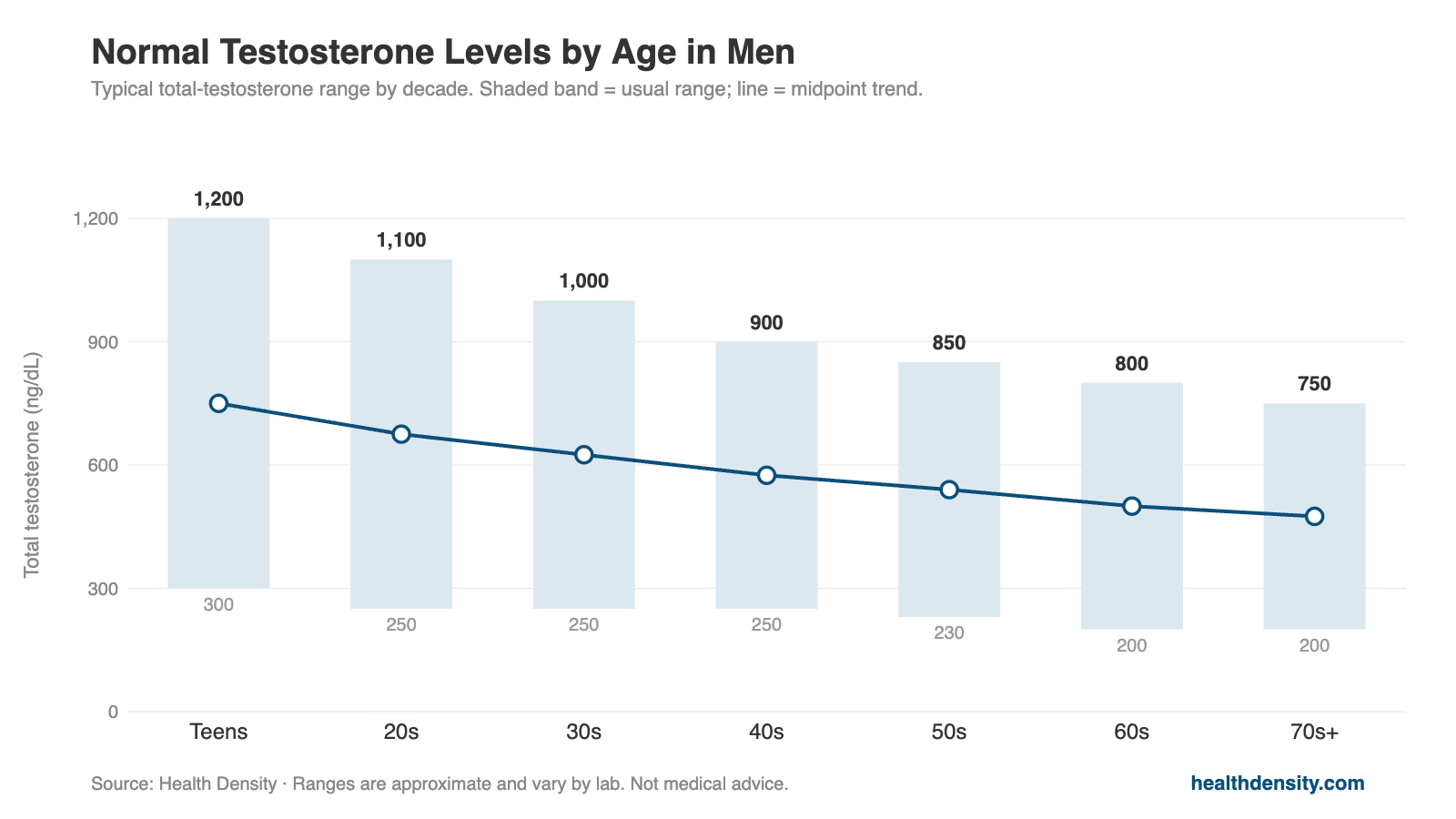
| Age | Typical total testosterone (ng/dL) | Total testosterone (nmol/L) | Approx. free testosterone (ng/dL)* |
|---|---|---|---|
| Teens (post-puberty) | ~300 to 1,200 | ~10.4 to 41.6 | ~6 to 24 |
| 20s (peak ~18 to 20) | ~250 to 1,100 | ~8.7 to 38.1 | ~5 to 22 |
| 30s | ~250 to 1,000 | ~8.7 to 34.7 | ~5 to 20 |
| 40s | ~250 to 900 | ~8.7 to 31.2 | ~5 to 18 |
| 50s | ~230 to 850 | ~8.0 to 29.5 | ~4 to 17 |
| 60s | ~200 to 800 | ~6.9 to 27.7 | ~4 to 16 |
| 70s+ | ~200 to 750 | ~6.9 to 26.0 | ~4 to 15 |
Treat these as typical population ranges, not personal targets. Individual variation is large. *Free testosterone is estimated as roughly 1.5 to 2% of total and is assay-dependent, so use your own lab’s range. To convert units, 1 ng/dL ≈ 0.0347 nmol/L.
Free testosterone is only about 1.5 to 2% of your total, but it is the unbound fraction that reaches your tissues, which is why it often tracks symptoms better than the total number. Confused by the difference? Read our full breakdown of free vs total testosterone and why free T matters more.
The clear pattern: testosterone peaks around age 18 to 20, then declines slowly, roughly 1% per year from the 30s onward. The bottom of the “normal” range drifts down with each decade, which is part of why what counts as concerning shifts with context.
What is a normal testosterone level for a young man?
Broad lab ranges lump a 25-year-old in with a 65-year-old, which hides a lot. A 2022 analysis in The Journal of Urology looked specifically at healthy men aged 20 to 44 and reported age-specific “normal” (middle-third) ranges, and they sit well above the old 300 ng/dL cutoff:
| Age | “Normal” total testosterone (ng/dL) | Total testosterone (nmol/L) |
|---|---|---|
| 20 to 24 | 409 to 558 | 14.2 to 19.4 |
| 25 to 29 | 413 to 575 | 14.3 to 19.9 |
| 30 to 34 | 359 to 498 | 12.4 to 17.3 |
| 35 to 39 | 352 to 478 | 12.2 to 16.6 |
| 40 to 44 | 350 to 473 | 12.1 to 16.4 |
So a 30-year-old reading 320 ng/dL is technically “in range” by the old cutoff, yet sits below the normal middle for his age. That gap is also why some men with “normal” results still feel the symptoms of low testosterone: fatigue, low drive, weight gain, and low mood can appear in the 300 to 400 ng/dL range even when a lab calls the number normal.
What Counts as “Low”?
This is where it gets contested:
- The American Urological Association and many providers define low testosterone as below 300 ng/dL.
- Some labs report down to 264 ng/dL as still within the normal range.
- The Endocrine Society suggests evaluating men with symptoms when levels are below 264 ng/dL on repeat testing, while noting that men in the 264 to 400 ng/dL range with significant symptoms fall into a clinical grey zone where individual assessment matters.
- Some researchers argue the healthiest men sit in the 400 to 600 ng/dL range, and that “low normal” isn’t truly optimal for everyone.
The takeaway: there’s no single magic number. A reading of 350 ng/dL might be fine for one man and leave another symptomatic. Which is exactly why doctors don’t treat the number in isolation.
Why the Number Alone Isn’t Enough
Two men can have identical total testosterone and feel completely different. Here’s why:
Free vs total testosterone. Most of your testosterone is bound to proteins (mainly SHBG and albumin) and isn’t biologically active. Only the small “free” fraction is available to your tissues. A man with normal total testosterone but high SHBG can have low free testosterone, and feel the symptoms, despite a normal-looking total. We explain this fully in our guide to free vs total testosterone (see also what is SHBG).
Symptoms. A number is only meaningful alongside how you feel. The clinical definition of low testosterone requires both a low level and symptoms, fatigue, low libido, lost muscle, low mood. We cover these in detail in our article on the signs of low testosterone (see also when to see a doctor about low testosterone).
Related: When to See a Doctor About Low Testosterone
So when you get your result, don’t fixate on the single total number. Ask about your free testosterone and SHBG too, and weigh it against your actual symptoms.
What Affects Your Levels (Beyond Age)
Age is only one factor. Several others can push your testosterone down, and many are reversible:
- Excess body fat, especially belly fat, which converts testosterone to estrogen
- Poor sleep and untreated sleep apnea
- Chronic stress and elevated cortisol
- Excessive alcohol
- Sedentary lifestyle and lack of resistance training
- Certain medications and medical conditions
This is encouraging news: a low-ish reading isn’t necessarily a life sentence of decline. Addressing weight, sleep, stress, and activity often raises levels meaningfully. We cover the practical levers in our guides on foods that boost testosterone and exercises to increase testosterone.
How to Get a Result You Can Trust
A testosterone number is only as good as the conditions it was taken under. The same man can produce a “low” result and a normal one in the same fortnight, depending on when and how the blood was drawn. The Endocrine Society’s guideline is specific about this, and the details are useful to know before you book a test.
Morning, fasting, twice
Testosterone follows a daily rhythm. It peaks in the early morning and falls through the day. Food and glucose can also push it down for a while after a meal. So the guideline asks for a total testosterone measured in the morning while fasting. It then asks for that result to be confirmed with a second morning, fasting sample on a different day.
A diagnosis of low testosterone should only be made when two things line up: symptoms and signs that fit, and levels that are clearly and consistently low. One afternoon result taken after lunch meets neither test.
When the total is borderline
If your total testosterone comes back near the lower end of the range, or you have something that changes SHBG, the protein that binds testosterone, the guideline recommends checking free testosterone as well. That is the portion your tissues can use. Obesity, ageing, diabetes and some medications all shift SHBG, so a borderline total can mean quite different things for different men. See free vs total testosterone for how the two relate.
A checklist before the needle
- Book the earliest appointment you can get, ideally before 10am.
- Skip breakfast. Water is fine.
- Avoid testing in the week after an illness, a very bad run of sleep or an unusually hard training block. All three can lower the number.
- If it comes back low, repeat it before accepting it. Same lab if possible, same time of day.
Following this does not guarantee a normal result. It does mean that whatever number you get is describing you.
FAQ: Testosterone Levels by Age
What is a normal testosterone level for a 40-year-old man?
Typically somewhere in the range of roughly 250 to 900 ng/dL, though the healthy and optimal point within that is individual. Many clinicians consider below 300 ng/dL low, particularly with symptoms.
What testosterone level is considered low?
Commonly below 300 ng/dL (AUA), with some labs using 264 ng/dL as the lower limit. The Endocrine Society treats 264 to 400 ng/dL with symptoms as a grey zone needing individual assessment.
When should I get my testosterone tested?
In the morning, before about 10 AM, when levels peak. Diagnosis usually requires two separate low morning readings.
Does testosterone really drop 1% a year?
A decline of roughly 1% per year from the 30s is commonly cited. The rate varies between individuals, and lifestyle factors can accelerate or offset it.
Is “low normal” testosterone a problem?
It can be, if you have symptoms. Some researchers argue the healthiest range is 400 to 600 ng/dL, so a “low normal” reading with bothersome symptoms is something to discuss with a doctor rather than dismissing.
The Bottom Line on Testosterone Levels by Age
The bottom line on testosterone levels by age: Testosterone peaks in your late teens and declines gradually with age, with the “normal” range being famously wide, roughly 264 to 916 ng/dL for younger men. Below 300 ng/dL is commonly considered low, but the number alone never tells the whole story: your free testosterone, your SHBG, and above all your symptoms determine what your level means for you. If you’re testing, do it in the morning, ask for the full picture rather than just total testosterone, and remember that many causes of low levels, weight, sleep, stress, are within your control.
This article is for informational purposes only and does not constitute medical advice. Consult a qualified healthcare professional to interpret your results.
Sources
- Harman SM et al. Longitudinal effects of aging on serum total and free testosterone levels in healthy men. Baltimore Longitudinal Study of Aging. J Clin Endocrinol Metab, 2001
- Cleveland Clinic: Testosterone, What It Is, Function, Levels and Imbalances
- Travison TG et al. Harmonized Reference Ranges for Circulating Testosterone Levels in Men of Four Cohort Studies in the United States and Europe. J Clin Endocrinol Metab, 2017
- Wu FC et al. Hypothalamic-pituitary-testicular axis disruptions in older men are differentially linked to age and modifiable risk factors: the European Male Aging Study. J Clin Endocrinol Metab, 2008
- Kelsey TW et al. A validated age-related normative model for male total testosterone shows increasing variance but no decline after age 40 years. PLoS One, 2014
- Evaluation and Management of Testosterone Deficiency, AUA Guideline
- Testosterone Therapy in Men With Hypogonadism: An Endocrine Society Clinical Practice Guideline (2018).