
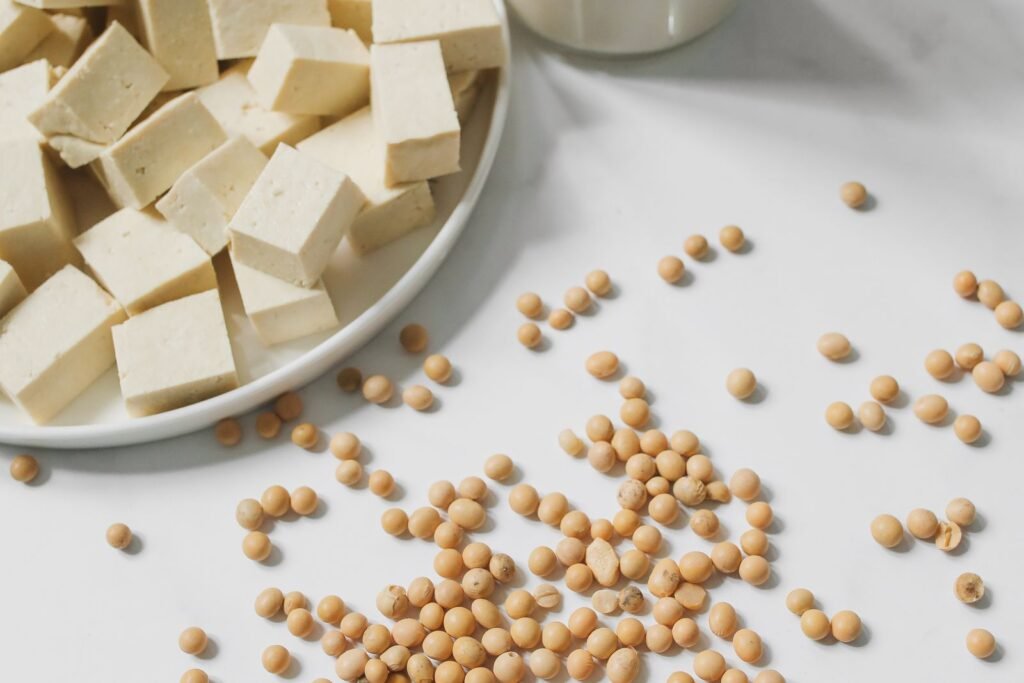
Few nutrition claims cause men more anxiety than the idea that soy lowers testosterone and “feminizes” men. It sounds logical: soy contains phytoestrogens (plant compounds that resemble estrogen), so surely eating it must raise estrogen and lower testosterone. This fear has been repeated endlessly on social media and in fitness circles for years. There’s just one problem: the large body of clinical evidence doesn’t support it. This guide gives you the real, evidence-based answer on soy and testosterone.
The Short Answer
Normal soy consumption does not lower testosterone in men, does not meaningfully raise estrogen, and does not cause feminization. This isn’t a matter of opinion. It’s the conclusion of pooled clinical evidence. If you enjoy soy foods, the evidence says you can eat them without worrying about your testosterone (see testosterone myths).
Let’s look at why this myth is so persistent, and what the research found.
Why People Believe Soy Lowers Testosterone
The theory sounds reasonable on the surface. Soy contains isoflavones, a type of phytoestrogen, plant compounds that can weakly bind to estrogen receptors in the body. The logical leap is: “phytoestrogens act like estrogen, estrogen is the opposite of testosterone, therefore soy must lower testosterone and feminize men.”
The fear was amplified by a few things: some early animal studies (where high doses affected hormones), a couple of dramatic case reports (like a man who consumed extreme amounts of soy), and sensationalist articles. These isolated findings got repeated until the myth felt like established fact. But isolated animal studies and extreme case reports don’t reflect what normal soy consumption does in real men, and that’s exactly what the clinical evidence examined.
What the Evidence Shows
In 2020, researchers published a comprehensive meta-analysis, pooling data from 41 clinical studies involving more than 1,700 men. A meta-analysis like this is the gold standard, it combines many studies to see the overall picture rather than relying on any single one.
The analysis examined the effects of both soy protein and soy isoflavones on a full range of male reproductive hormones: total testosterone, free testosterone, estrogen (estradiol), estrone, and SHBG. The conclusion was clear: neither soy protein nor soy isoflavones had any statistically significant effect on testosterone or other reproductive hormones in men.
This held across the entire dose range studied, from modest to high isoflavone intakes. No lowering of testosterone. No meaningful raising of estrogen. No hormonal feminization. The large, high-quality evidence simply doesn’t support the myth.
The Real-World Evidence Too
Beyond the clinical studies, consider the population-level reality: men in Japan, South Korea, and China have consumed soy as a dietary staple for centuries, in amounts far exceeding the typical Western diet. If soy meaningfully lowered testosterone or feminized men, these populations would show it, and they don’t. This real-world evidence aligns with the clinical findings: normal, even high, soy consumption doesn’t harm male hormones.
The Sensible Perspective
A balanced view on soy for men:
- Normal soy consumption is fine and doesn’t harm your testosterone or hormones. Enjoy tofu, edamame, tempeh, soy milk, and other soy foods without worry.
- Soy is a quality protein source: a complete plant protein useful for hitting your protein targets, especially valuable for those eating less meat (see how much protein men need).
- Soy has potential health benefits: some research associates it with cardiovascular and other benefits.
- As with anything, extreme amounts aren’t necessary: a normal, varied diet including soy is perfectly healthy. You don’t need to load up on soy, but you certainly don’t need to fear it.
So if you’ve been avoiding soy out of fear for your testosterone, you can stop, that fear isn’t supported by the evidence. Your testosterone is far more affected by your body fat, sleep, stress, and training than by whether you eat tofu (see increase testosterone after 50 and foods that boost testosterone).
The Numbers Behind the Answer
This question has been studied more thoroughly than almost any other food and hormone claim, largely because the belief is so persistent. It is worth seeing the actual scale of the evidence rather than taking the conclusion on trust.
What the pooled analysis covers
An expanded and updated meta-analysis brought together 41 clinical studies, covering 1,753 men for total testosterone and 752 for free testosterone.
The finding: neither soy protein nor isoflavone exposure affected total testosterone, free testosterone, oestradiol or oestrone. That held regardless of the dose used and regardless of how long the studies ran, and it held across different statistical models. An earlier meta-analysis found the same for testosterone, SHBG, free testosterone and free androgen index.
A separate review looking specifically at whether isoflavones produce feminising effects in men concluded that the clinical evidence does not support it, and found essentially no evidence across the identified studies that isoflavone exposure changes circulating oestrogen levels in men.
This is about as close to settled as nutrition research gets. It is not one study that could be overturned next year. It is dozens, across a range of doses and durations, pointing the same way.
The one real exception
There is a published case report of a man who developed secondary hypogonadism after consuming isoflavones in extreme quantities. It is worth mentioning for accuracy, and worth keeping in proportion.
A single case report describes an extreme that nobody reaches by eating tofu or drinking soy milk, and it does not overturn 41 controlled studies. It is the same category of fact as water being dangerous in sufficient volume: true, and not a reason to change what you do.
Soy Protein for Building Muscle
Once the hormone question is settled, a practical one follows. If soy does not lower testosterone, is soy protein any good for building muscle compared with whey?
What the comparisons show
A 2018 meta-analysis pooled trials in which people did resistance training while taking either soy protein or animal protein, mostly whey but also beef and dairy. Both groups got stronger on the bench press and squat, and both gained muscle. There was no difference between the protein sources.
A later 12 week randomised trial in men and women reached the same conclusion, with one detail that matters. The soy and whey doses were matched for leucine, the amino acid that does most of the work of switching on muscle building. Matched that way, gains in lean mass and strength were comparable.
The catch
An earlier study that did not match leucine found whey ahead: 3.3 kg of lean mass gained against 1.8 kg for soy. Soy protein has a little less leucine per gram than whey. So gram for gram, whey has a small edge. Take slightly more soy and the gap closes.
In practice, if you prefer soy, or avoid dairy, you are not choosing a weaker option. Take a somewhat bigger serving than you would of whey, or pick a blend that adds leucine. Your total daily protein matters far more than which tub it came from. For the numbers on that, see how much protein men need.
Frequently Asked Questions
Does soy lower testosterone in men?
No. A comprehensive 2020 meta-analysis of 41 clinical studies (over 1,700 men) found that neither soy protein nor soy isoflavones had any statistically significant effect on testosterone. Normal soy consumption doesn’t lower testosterone.
Does soy raise estrogen or feminize men?
No. The same meta-analysis found no meaningful effect on estrogen levels in men, and no evidence of feminization. Populations that consume large amounts of soy for centuries show no such effects. The feminization claim isn’t supported by evidence.
Why do people think soy lowers testosterone?
The theory sounds logical (soy contains phytoestrogens), and it was amplified by isolated animal studies, extreme case reports, and sensationalist articles. But these don’t reflect what normal soy consumption does in men, which clinical evidence shows is no hormonal effect.
Is soy safe for men to eat?
Yes. Normal soy consumption is safe and doesn’t harm testosterone or hormones. Soy is also a quality complete plant protein with potential health benefits. You can enjoy soy foods without worrying about your masculinity or hormones.
How much soy is too much for men?
Clinical studies found no hormonal effects even at high isoflavone intakes, and populations consuming large amounts show no problems. A normal, varied diet including soy is perfectly healthy: you don’t need to load up on it, but you don’t need to fear it either.
The Bottom Line
The claim that soy lowers testosterone and feminizes men is one of the most persistent myths in men’s nutrition, and the evidence definitively debunks it. A comprehensive meta-analysis of 41 clinical studies involving over 1,700 men found that neither soy protein nor soy isoflavones had any significant effect on testosterone, estrogen, or other male hormones, across the full dose range. Real-world evidence agrees: populations eating large amounts of soy for centuries show no hormonal harm. The myth arose from isolated animal studies, extreme case reports, and sensationalism, not from what normal soy consumption does. So if you’ve been avoiding soy out of fear for your testosterone, you can stop. Enjoy it as the quality plant protein it is, and focus your testosterone concerns on what matters: your body fat, sleep, stress, and training.
This article is for informational purposes only and does not constitute medical advice. Consult a qualified healthcare professional or registered dietitian for personalised dietary guidance.
Sources
- Reed KE et al. Neither soy nor isoflavone intake affects male reproductive hormones: An expanded and updated meta-analysis of clinical studies. Reprod Toxicol, 2021
- Hamilton-Reeves JM et al. Clinical studies show no effects of soy protein or isoflavones on reproductive hormones in men: results of a meta-analysis. Fertil Steril, 2010
- Messina M. Soybean isoflavone exposure does not have feminizing effects on men: a critical examination of the clinical evidence. Fertil Steril, 2010
- Soybean isoflavone exposure does not have feminizing effects on men: a critical examination of the clinical evidence.
- No Significant Differences in Muscle Growth and Strength When Consuming Soy and Whey Protein Supplements Matched for Leucine.
- Animal Protein versus Plant Protein in Supporting Lean Mass and Muscle Strength: A Systematic Review and Meta-Analysis.