
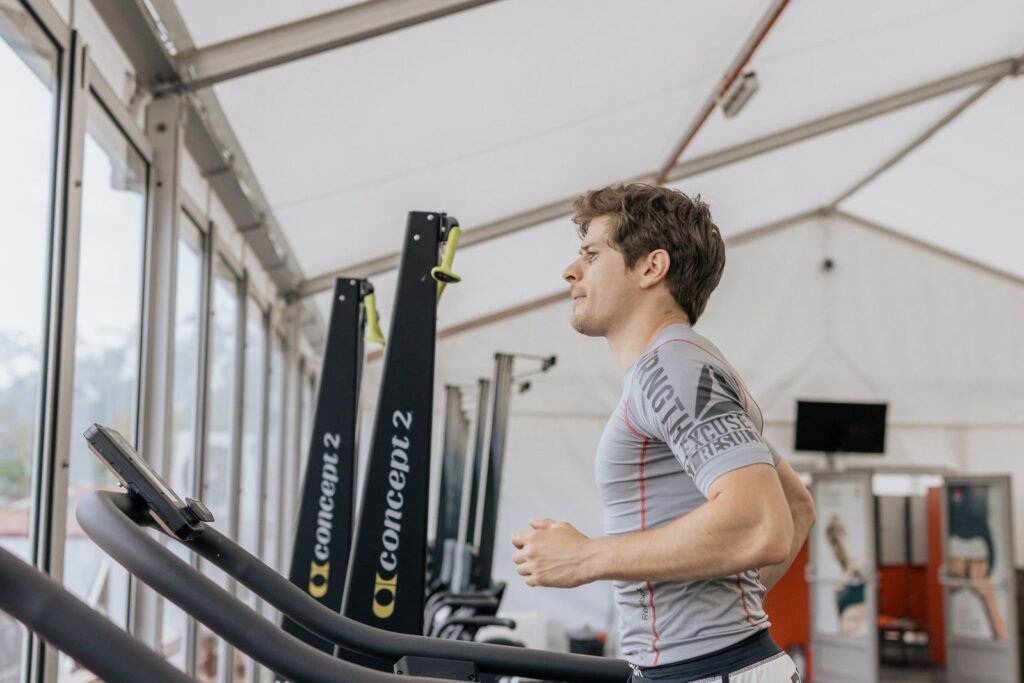
It’s one of the oldest arguments in fitness, and it’s usually argued badly, because the people on each side are answering different questions. Cardio burns more calories per session. Weights change what your body does with calories for the rest of the day and the rest of the year. Which one “wins” depends on whether you’re measuring a single workout or a body over a decade, and for men over 30 the answer to the second question is the one that matters. Below is a fair comparison of cardio and weights for fat loss, and how to use both together.
This guide breaks down what each does, what the research says when they’re compared head-to-head, and the combination that produces the best fat loss with the least muscle loss.
What Cardio Does for Fat Loss
Steady cardio burns a meaningful number of calories while you’re doing it: roughly 8 to 12 kcal per minute for a moderate run, less for walking or cycling. That’s the whole case, and it’s a real one. Cardio is the most direct way to increase daily energy expenditure without changing what you eat, and it improves the cardiovascular fitness that underpins long-term health.
Its limitations are also real. The calorie burn stops when the session stops. Cardio alone does nothing to preserve muscle in a deficit, and in large volumes it can contribute to muscle loss. And the body adapts: as you get fitter and lighter, the same session burns fewer calories. Zone 2 cardio is the most sustainable form because it’s low-stress and recoverable, but it’s still a per-session calorie tool.
What Lifting Does for Fat Loss
A weights session burns fewer calories than a comparable run, typically 5 to 8 kcal per minute. If that were the whole story, cardio would win. It isn’t.
Resistance training does three things cardio doesn’t. First, it signals the body to keep muscle during a calorie deficit, so a larger share of what you lose is fat. Second, muscle is metabolically active tissue; more of it means a higher resting energy expenditure, modestly but permanently. Third, lifting produces a longer post-exercise oxygen consumption effect, raising calorie burn for hours afterward. For men over 40, there’s a fourth: it directly counters age-related muscle loss, which otherwise accelerates in a deficit.

Head-to-Head: What the Research Shows
| Outcome | Cardio only | Weights only | Both combined |
|---|---|---|---|
| Total weight lost | Highest | Lowest | Similar to cardio |
| Fat lost | High | Moderate | Highest |
| Muscle retained | Some loss | Preserved or gained | Preserved or gained |
| Body composition change | Moderate | Good | Best |
| Long-term maintenance | Weaker | Stronger | Strongest |
The pattern across trials is consistent. Cardio-only groups often lose the most total weight but a portion of it is lean mass. Weights-only groups lose less on the scale but improve body composition more. Combined groups lose as much fat as cardio groups while keeping or building muscle, and they’re the most likely to keep the weight off. A well-cited Duke University trial comparing the three approaches found exactly this: cardio for weight and fat loss, weights for lean mass, and the combination for the best overall body composition.
One nuance: when calories are strictly controlled, the difference in fat loss between approaches narrows considerably. Diet drives fat loss; training determines what kind of weight you lose. That is why our guide to building muscle in a deficit treats lifting as non-negotiable and cardio as adjustable.
The Practical Answer for Men Over 30
Lift two to four times a week, built around the big compound lifts, and treat this as the foundation. It protects muscle, keeps your resting metabolism up, and has benefits that extend far beyond fat loss.
Add cardio as the adjustable lever: 2 to 4 sessions of 30 to 45 minutes, mostly Zone 2, plus daily walking. When fat loss stalls, increase cardio or steps rather than cutting calories further. When recovery suffers, reduce cardio first. If you’re short on time, prioritise the weights session and get your cardio from walking and daily movement.
And keep the deficit moderate. Neither training style can rescue an eating pattern that’s too far above maintenance, and neither is worth pushing to the point where you can’t recover.
HIIT: Where Does It Fit?
High-intensity intervals burn calories efficiently and improve fitness quickly, but they’re demanding to recover from and easy to overdo alongside lifting. One or two short sessions a week is plenty for most men. Research comparing HIIT with steady cardio for fat loss finds broadly similar results per unit of time; the main advantage of HIIT is time efficiency, not a special fat-burning effect.
FAQ: Cardio vs Weights for Fat Loss
Some quick answers on cardio vs weights for fat loss:
Which burns more fat, cardio or weights?
Per session, cardio burns more calories. Over months, combining both produces the most fat loss with the best body composition, because weights preserve the muscle that keeps your metabolism up.
Can you lose fat with weights only?
Yes, provided you’re in a calorie deficit. You’ll lose less on the scale than with cardio but keep more muscle, so the fat-loss quality is higher.
Should I do cardio before or after weights?
If both are in the same session, lift first. Cardio beforehand reduces lifting performance more than the reverse. Better still, separate them by a few hours or put them on different days.
How much cardio is too much when cutting?
If it’s hurting your lifts, your sleep, or your recovery, it’s too much. Most men do well with 2 to 4 moderate sessions a week plus walking; large volumes of intense cardio in a deficit tend to cost muscle.
The Bottom Line on Cardio vs Weights for Fat Loss
The bottom line on cardio vs weights for fat loss: Cardio burns more calories in the moment; weights preserve the muscle that determines what you lose and how well you keep it off. Head-to-head research consistently shows the combination wins: as much fat loss as cardio alone, with muscle retained or gained. For men over 30, build the week around two to four lifting sessions, use cardio and daily steps as the adjustable lever, and keep the deficit moderate. It’s not cardio or weights; it’s weights first, cardio to taste.
This article is for informational purposes only and does not constitute medical advice. Consult a qualified healthcare professional before starting a new exercise programme, especially if you have health conditions.
Sources
- Harvard Health Publishing on combining cardio and strength training.
- Mayo Clinic on the benefits of strength training.
- Willis LH et al. Effects of aerobic and/or resistance training on body mass and fat mass in overweight or obese adults. J Appl Physiol (1985), 2012
- Bryner RW et al. Effects of resistance vs. aerobic training combined with an 800 calorie liquid diet on lean body mass and resting metabolic rate. J Am Coll Nutr, 1999