
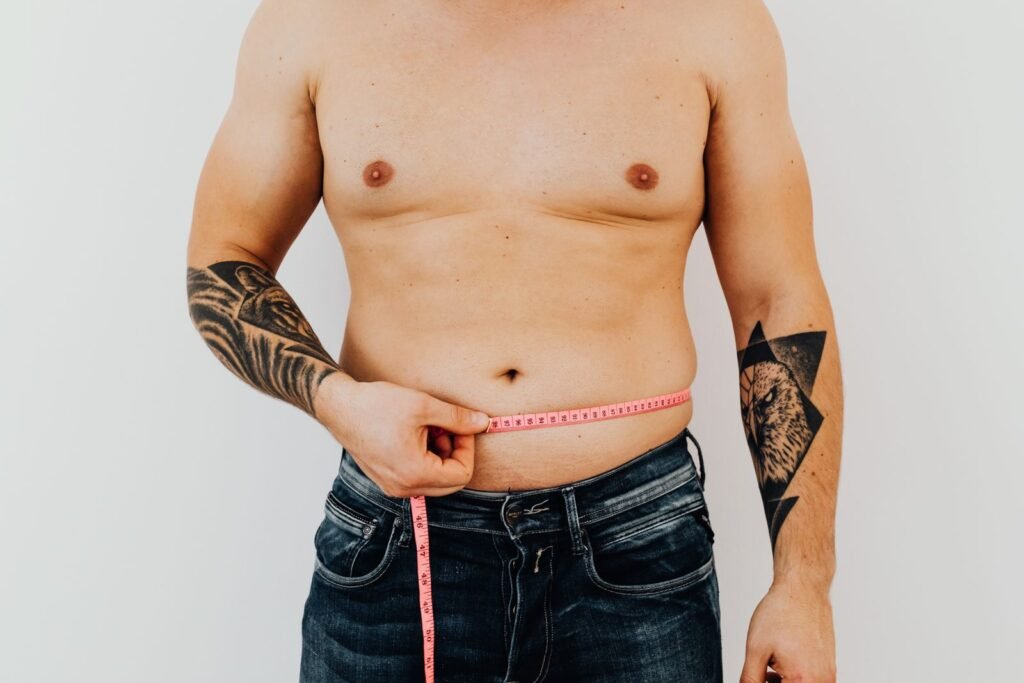
The internet is full of “lose 20 pounds in 30 days” promises, and the answer is that some of that is possible, but most of it isn’t fat. What you can realistically lose, what you should aim for, and what the number on the scale represents in the first month are three different questions, and conflating them is why so many men start strong and quit by week six. So how much weight can you lose in a month without wrecking your muscle? Here is the realistic range.
This guide gives you real numbers: the safe rate of fat loss, why the first month is misleading, what determines your personal ceiling, and how to set a target you’ll hit.
The Realistic Number: Fat Loss vs Weight Loss
Sustainable fat loss for most men runs at 0.5 to 1% of body weight per week. For a 90 kg (200 lb) man, that is roughly 0.45 to 0.9 kg (1 to 2 lb) a week, or about 2 to 4 kg (4 to 8 lb) of fat in a month. Heavier men with more fat to lose can safely sit at the upper end or slightly beyond; leaner men should expect the lower end.
The scale, however, will often show more than that in month one, sometimes considerably more. That is because early weight loss includes water and glycogen, not just fat. Understanding the difference is the single most important thing about interpreting your first four weeks.
Why the First Month Is Misleading
When you start a calorie deficit, especially one that reduces carbohydrates, your body draws down its glycogen stores. Each gram of glycogen is stored with around 3 grams of water, and most men carry 400 to 500 g of glycogen. Depleting it can drop 1.5 to 2.5 kg (3 to 5 lb) of scale weight in the first week or two, none of which is fat. Lower sodium intake and reduced food volume in the gut add to the effect.
So a man who “loses 5 kg in the first month” may have lost 2.5 kg of fat and 2.5 kg of water. That is not a failure; the fat loss is real and on track. But the water component does not repeat in month two, which is why progress appears to “slow” dramatically. It didn’t slow. The illusion just ended. This is also why plateaus feel so sudden after a fast start.
What Determines Your Personal Ceiling
| Factor | Effect on monthly fat loss |
|---|---|
| Starting body fat | Higher body fat allows faster, safer loss; lean men must go slower to protect muscle |
| Deficit size | A 500 kcal/day deficit yields roughly 2 kg (4 lb) of fat per month; 750 kcal/day roughly 3 kg (6 lb) |
| Protein intake | Adequate protein (around 1.6 to 2.2 g/kg) keeps losses as fat rather than muscle |
| Resistance training | Signals the body to retain muscle; without it, a larger share of loss is lean tissue |
| Sleep and stress | Poor sleep and high cortisol shift losses toward muscle and increase water retention |
The deficit arithmetic is the anchor. Fat holds roughly 7,700 kcal per kg (3,500 per lb). A 500 kcal daily deficit therefore produces about 2 kg (4.5 lb) of fat loss over 30 days. Doubling the deficit doubles the theoretical loss but sharply increases muscle loss, hunger, and the odds of quitting, which is why our guide to losing weight quickly and safely recommends against it for most men.
Faster Isn’t Better: What Aggressive Deficits Cost
Very low-calorie approaches (under 1,200 to 1,500 kcal for most men) can produce 5 to 8 kg (10 to 18 lb) of scale loss in a month. Research shows a meaningful share of that is lean mass, and the metabolic adaptation that follows is larger. Men who lose muscle in a diet end up with a lower maintenance calorie level, making regain more likely and future fat loss harder. The muscle you lose after 40 is also harder to rebuild than it was at 25.
The practical rule: if you’re losing more than about 1% of body weight a week for several weeks, and you’re not very overweight, you are almost certainly losing muscle along with fat. Slow down, raise protein, and keep lifting. Building or keeping muscle in a deficit is entirely possible when the deficit is moderate.
Setting a Target You’ll Hit
Take your current weight, multiply by 0.005 and 0.01 to get your weekly range, then multiply by four. That is your realistic monthly fat-loss target. For most men it lands between 2 and 4 kg (4 to 8 lb). Add 1 to 2 kg of expected water loss in month one only.
Track weekly averages rather than daily readings, and pair the scale with a waist measurement, since the waist-to-height ratio tracks fat loss more directly. If you’re eating around 1.6 to 2.2 g/kg of protein, lifting two to four times a week, and sleeping adequately, the loss you see will be overwhelmingly fat.
FAQ: How Much Weight Can You Lose in a Month
Some quick answers on how much weight can you lose in a month:
Is losing 10 pounds in a month realistic?
For a man over about 90 kg (200 lb) with a moderate deficit, yes, particularly in month one when water loss adds to fat loss. For lighter or leaner men, 10 lb of actual fat in a month would require an aggressive deficit that costs muscle.
Can you lose 20 pounds in a month?
On the scale, possibly, with a very aggressive approach. As fat, no, not safely. Roughly half or more of that would be water and lean tissue.
Why did I lose a lot in week one and then almost nothing?
Week one included glycogen and water depletion. That component doesn’t repeat. Your fat loss rate likely didn’t change; the water illusion ended.
What’s the safest rate of weight loss for men over 40?
About 0.5 to 1% of body weight per week, with protein kept high and resistance training in place to protect muscle. Faster rates accelerate age-related muscle loss.
The Bottom Line on How Much Weight Can You Lose in a Month
The bottom line on how much weight can you lose in a month: Realistic, sustainable fat loss is 0.5 to 1% of body weight per week, or roughly 2 to 4 kg (4 to 8 lb) a month for most men, with an extra 1 to 2 kg of water in the first month only. Larger monthly losses are possible but come mostly from water and muscle, not fat, and they set you up for regain. Set a target from the arithmetic, judge progress by weekly averages and your waist, and keep protein and lifting in place so what you lose is fat.
This article is for informational purposes only and does not constitute medical advice. Consult a qualified healthcare professional before starting a weight-loss programme, especially if you have health conditions.
Sources
- CDC guidance on healthy, sustainable rates of weight loss.
- Mayo Clinic on setting realistic weight-loss goals.
- Harvard Health Publishing on diet and weight loss.
- Stefanakis K et al. The impact of weight loss on fat-free mass, muscle, bone and hematopoiesis health: Implications for emerging pharmacotherapies aiming at fat reduction and lean mass preservation. Metabolism, 2024