
You don’t need a fancy lab or expensive equipment to get a useful picture of your fitness. A handful of simple self-tests you can do at home reveal how you’re doing across strength, cardiovascular fitness, mobility, and more, giving you a baseline to track your progress and spot areas to work on. This guide covers each practical fitness test you can do at home and how to use the results. One note upfront: these are general self-assessments, not medical tests, if you have health concerns or haven’t exercised in a while, check with a doctor before testing hard.
Why Test Your Fitness at Home
Simple fitness self-tests are useful because they:
- Establish a baseline: knowing where you stand now lets you measure improvement over time.
- Reveal strengths and weaknesses: showing which areas (strength, cardio, mobility) need work.
- Track your progress: retesting periodically shows whether your training is working, which is motivating.
- Require no lab or expense: you can do them at home with little or no equipment.
The goal isn’t precision like a laboratory test, but a practical, repeatable way to gauge and track your fitness. Consistency in how you test matters more than perfect accuracy, test the same way each time to make comparisons meaningful.
Simple At-Home Fitness Tests
Cardiovascular fitness
Resting heart rate. Measure your pulse (or use a wearable) first thing in the morning at rest. A lower resting heart rate generally indicates better cardiovascular fitness (see lower resting heart rate and good resting heart rate for men by age). Track it over time, a decreasing resting heart rate suggests improving fitness.
A simple cardio test. You can gauge cardiovascular fitness with tests like how you handle a set period of brisk activity, or the classic “how out of breath do you get climbing several flights of stairs.” A practical marker: being able to climb a few flights of stairs without getting very winded suggests reasonable cardiovascular fitness; getting very breathless suggests room for improvement. For a rough VO2 max estimate, wearables and various step/walk tests exist (see good vo2 max by age).
The talk test during exercise also gauges your zone 2 and cardiovascular capacity (see zone 2 cardio).
Strength and muscular endurance
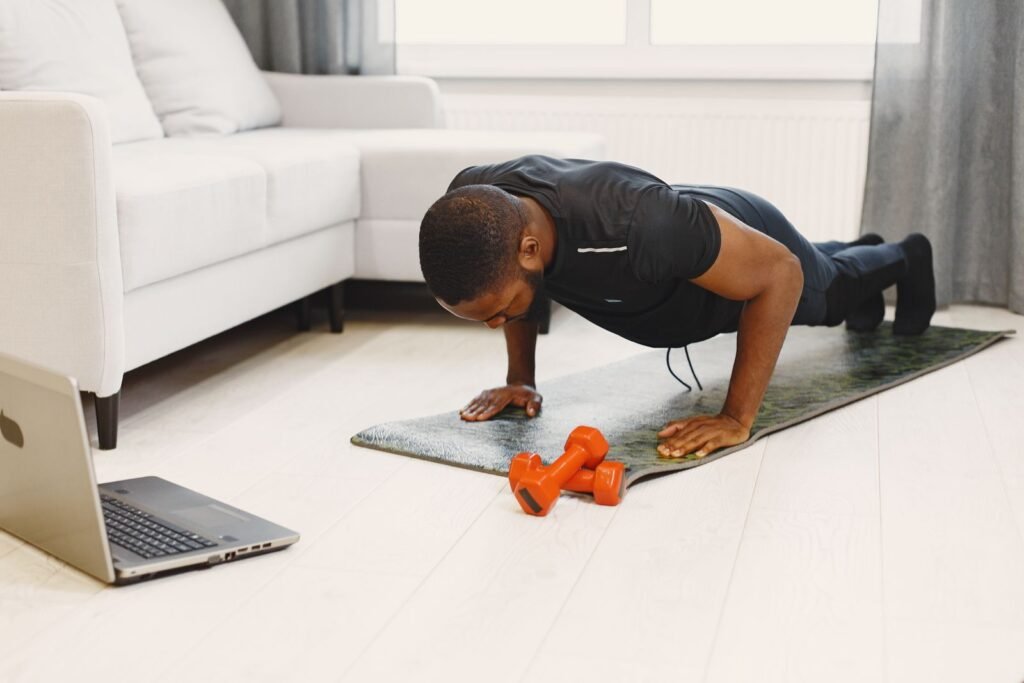
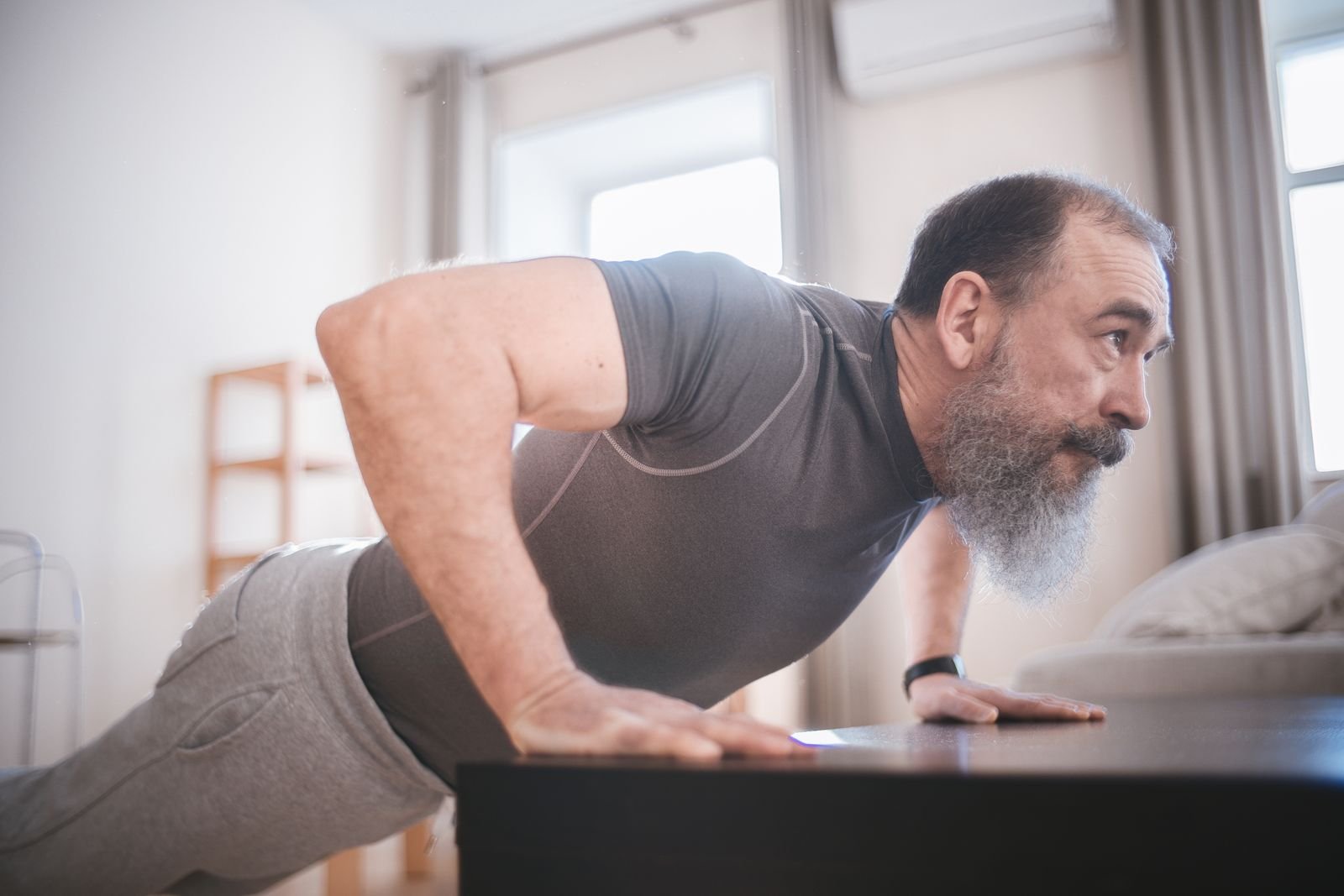
Push-up test. Do as many good-form push-ups as you can in one set. This tests upper-body strength and endurance. Track the number over time (see best compound lifts for building the underlying strength).
Bodyweight squat test. How many bodyweight squats you can do (or holding a wall-sit for time) tests lower-body strength and endurance.
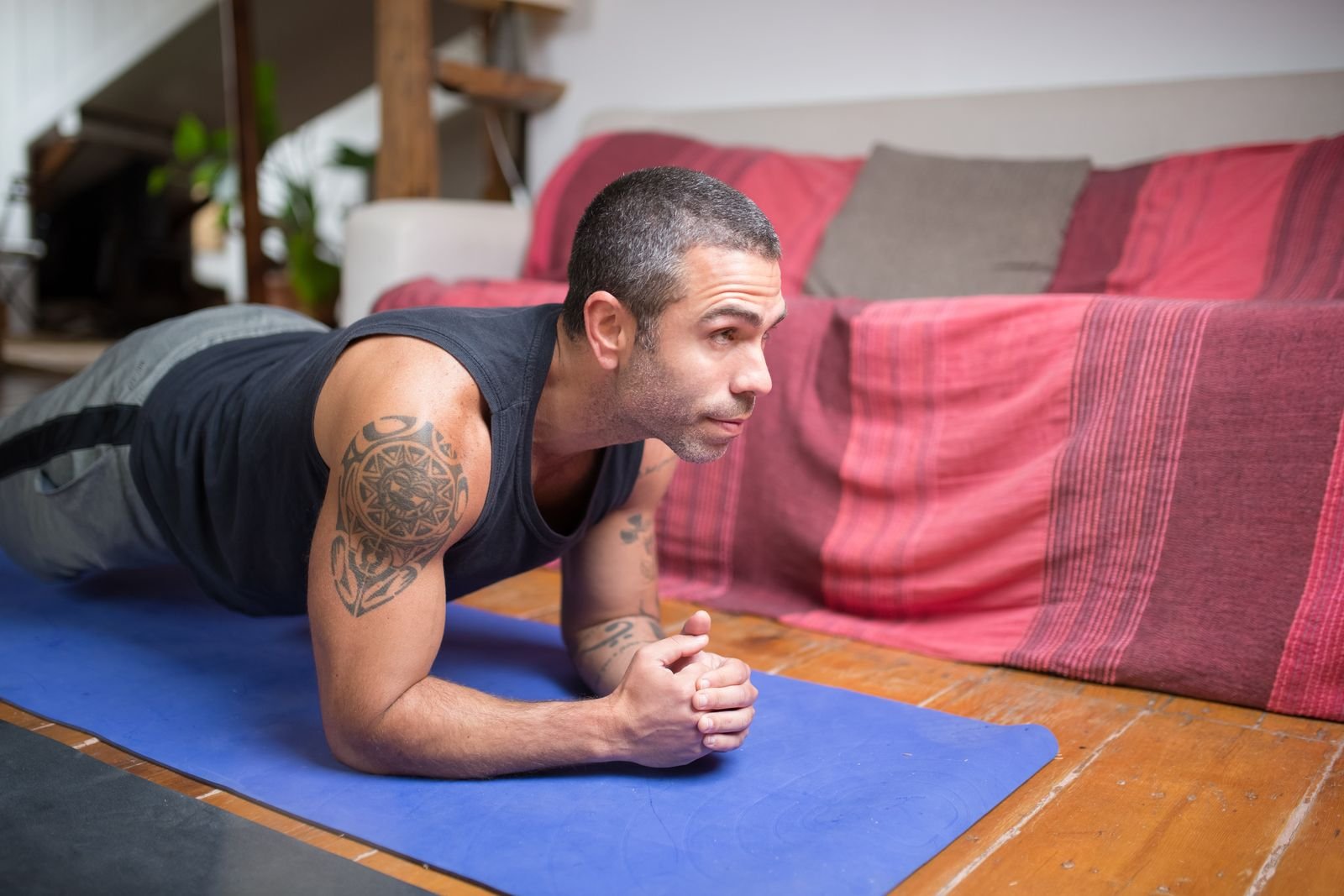
Plank hold. How long you can hold a proper plank tests core strength and endurance.
Grip strength. If you have a way to measure it (or simply how you handle carrying/hanging), grip strength is a valuable marker, and remarkably, a predictor of longevity (see grip strength and longevity and grip strength training).
These simple strength tests, tracked over time, show your progress and highlight areas to develop.
Mobility and flexibility
Sit-and-reach type tests (reaching toward your toes) gauge hamstring and lower-back flexibility. Deep squat mobility (can you squat down fully with good form?) and overhead reach assess mobility in key areas. Poor mobility here highlights areas to work on (see mobility for men over 40).
Getting up from the floor (how easily you can get down to and up from the floor) is a simple functional test that reflects strength, mobility, and balance together, and is relevant for healthy aging.
Balance
Single-leg stand. How long you can balance on one leg (especially with eyes closed) tests your balance, which matters for function and fall prevention as you age.
Body composition
Waist measurement. Measuring your waist (and calculating your waist-to-height ratio) is a simple, useful indicator of healthy body composition and visceral fat risk (see waist-to-height ratio and body fat percentage). Easy to track at home.
How to Use Your Results
To make these tests useful:
- Establish your baseline. Do the tests, record your results, and note where you stand across the different areas.
- Identify weak areas. See which areas (cardio, strength, mobility, balance, body composition) are lagging, and prioritise them in your training.
- Retest periodically. Repeat the tests every so often (say, every 1 to 3 months) to track your progress. Improvement is motivating and confirms your training is working (see how long to build muscle for realistic timelines).
- Test consistently. Do each test the same way each time (same conditions, form, and measurement) so your comparisons are meaningful.
- Use results to guide training. Let your weak areas direct where you focus, if your mobility is poor, add mobility work (see mobility for men over 40); if your cardio is weak, add zone 2 (see zone 2 cardio); if strength is lacking, prioritise resistance training (see building muscle after 40).
The value is in tracking your own progress and addressing your weak points over time, not in comparing your absolute numbers to others.
What a Push-Up Count Predicted
Of all the tests above, the push-up has the most interesting research behind it. A study of male firefighters in Indiana, published in JAMA Network Open, asked a simple question. Does the number of push-ups a man can do predict his risk of heart disease?
The researchers followed 1,104 men, average age about 40, for ten years. At the start, each did as many push-ups as he could in time with a metronome. Over the decade, 37 of them had a cardiovascular event.
Men who could complete more than 40 push-ups had about 96 percent lower risk of a cardiovascular event than men who managed fewer than 10. The risk fell steadily as the count went up. In this group, push-up capacity was a better predictor than a treadmill estimate of aerobic fitness.
How much weight to put on it
Be careful with that 96 percent. It rests on only 37 events, so the true effect could be considerably smaller. The group was also all male, fairly young and physically active, which limits how far the result applies to everyone else. And this is an association. Push-ups do not protect your heart directly. They reflect a level of strength, body composition and general fitness that does.
What makes it useful is how easy it is to use. It needs no equipment and takes a minute. If you can do fewer than 10 good push-ups, treat it as a flag worth acting on. If you are climbing past 20, 30 and 40 over the months, that is progress you can measure at home. Test it the same way each time: full range of motion, chest close to the floor, body straight, no pausing at the top.
Frequently Asked Questions
How can I test my fitness at home?
Use simple self-tests: resting heart rate and a stair-climb or talk test for cardio, push-ups, squats, and plank holds for strength and endurance, sit-and-reach and deep squat for mobility, single-leg stand for balance, and a waist measurement for body composition. Record your results as a baseline and retest over time.
What’s a good fitness test for strength?
Simple bodyweight tests work well: how many good-form push-ups you can do in one set (upper body), bodyweight squats or a wall-sit (lower body), and how long you can hold a proper plank (core). Grip strength is also valuable. Track the numbers over time to see progress.
How do I test my cardiovascular fitness at home?
Measure your resting heart rate (lower generally means fitter), gauge how winded you get climbing several flights of stairs, or use the talk test during exercise. Wearables and step/walk tests can estimate VO2 max. Track these over time to see your cardiovascular fitness improving.
How often should I test my fitness?
Retest periodically, roughly every 1 to 3 months, to track your progress meaningfully without testing so often that changes are negligible. Test consistently (same conditions and form each time) so your comparisons are valid. Regular retesting shows whether your training is working.
Do I need equipment to test my fitness?
No, most useful fitness self-tests require little or no equipment: push-ups, squats, planks, and balance tests use just your bodyweight, and a tape measure covers body composition. A wearable helps for heart rate but isn’t essential. You can gauge your fitness at home with minimal gear.
The Bottom Line
You don’t need a lab or expensive equipment to get a useful picture of your fitness, a handful of simple self-tests you can do at home reveal how you’re doing across strength, cardiovascular fitness, mobility, balance, and body composition. For cardio, track your resting heart rate and how winded you get climbing stairs; for strength, count push-ups and squats and time a plank hold; for mobility, try sit-and-reach and a deep squat; for balance, a single-leg stand; and for body composition, measure your waist.
The value comes from establishing a baseline, identifying your weak areas, and retesting periodically (every 1 to 3 months) to track progress, testing consistently each time so comparisons are meaningful. Use your results to guide your training toward your weak points. These aren’t precise medical tests, but they’re a practical, repeatable, no-cost way to gauge and track your fitness over time, and to keep yourself motivated and on target. If you have health concerns, check with a doctor before testing hard.
This article is for informational purposes only and does not constitute medical advice. These are general self-assessments, not medical tests. Consult a qualified healthcare professional before intense exercise if you have health concerns or have been inactive.
Sources
- Ross R et al. Importance of Assessing Cardiorespiratory Fitness in Clinical Practice: A Case for Fitness as a Clinical Vital Sign: A Scientific Statement From the American Heart Association. Circulation, 2016
- Yang J et al. Association Between Push-up Exercise Capacity and Future Cardiovascular Events Among Active Adult Men. JAMA Netw Open, 2019
- Brito LB et al. Ability to sit and rise from the floor as a predictor of all-cause mortality. Eur J Prev Cardiol, 2014