
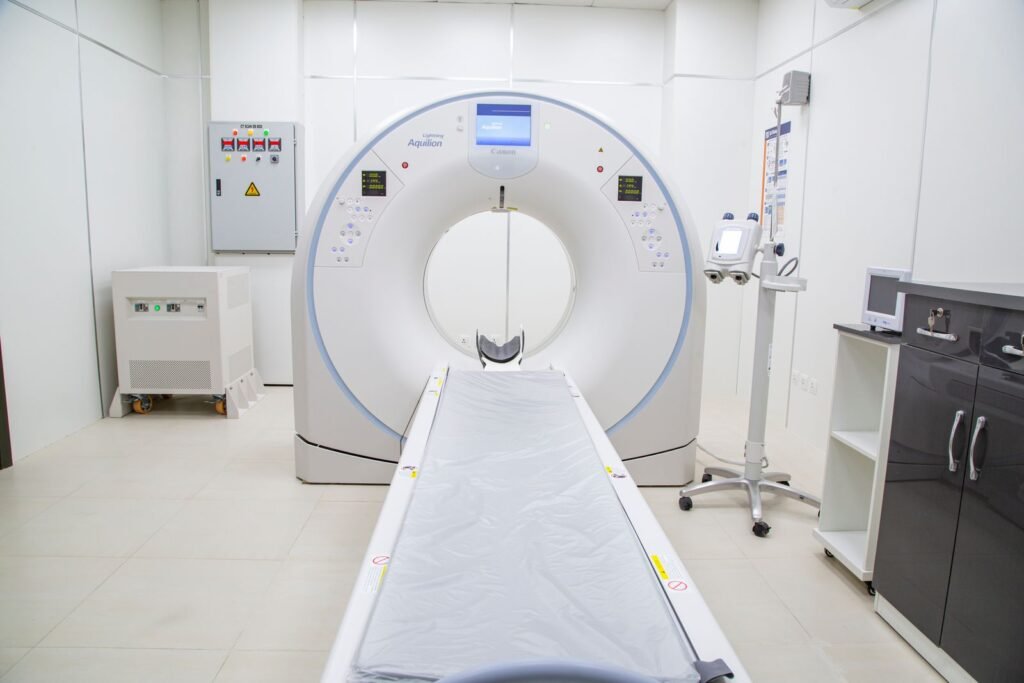
A coronary calcium score is a single number from a quick CT scan that shows how much hardened plaque has already built up in the arteries of your heart. Most risk tools estimate your chance of a heart attack from things like cholesterol and blood pressure. A calcium scan looks at the arteries directly. For a man in his 40s or 50s who is unsure whether he needs a statin, it can settle the question either way.
This guide explains what the scan involves, what each score means, who should consider one under the 2026 American cholesterol guideline, and what a result of zero does and does not tell you.
Wondering what treatment would involve? Our guide to statins explains how they work and what blinded trials show about side effects.
In this guide
What a coronary calcium score measures
Plaque builds up inside artery walls slowly, over decades. As it matures, some of it hardens with calcium. That calcium shows up clearly on a CT scan, and software adds it up into a score measured in Agatston units (AU), named after the doctor who developed the method.
The score is a marker of how much atherosclerosis you have, the disease process behind most heart attacks. It does not measure every type of plaque, and it does not show whether an artery is narrowed. What it shows well is the overall plaque burden. According to a summary of the 2026 guideline, people at intermediate risk with a score of zero have low observed 10-year rates of heart attack and stroke, while those with a score of 100 or more have rates similar to people at high risk.
That is why the score is useful. Two men with the same cholesterol and blood pressure can have very different arteries, and the scan tells you which one you are.
What the scan involves
A calcium scan is a non-contrast CT scan of the chest, timed to your heartbeat. You lie on a table for a few minutes while the scanner takes images. There are no needles, no dye and no preparation beyond avoiding caffeine if the centre asks you to.
The radiation dose is low. A 2022 study in the Texas Heart Institute Journal measured an average effective dose of about 1 mSv on a standard 64-slice scanner and 0.84 mSv on a newer 256-slice scanner, which the authors describe as similar to lung cancer screening and mammography.
Insurance often does not cover a calcium scan for screening, so check the self-pay price with the imaging centre before you book.
Who should consider a coronary calcium score
The scan is not for everyone. The 2026 ACC/AHA dyslipidemia guideline recommends selective use in men aged 40 or older (and women aged 45 or older) whose estimated 10-year risk of heart attack or stroke is borderline (3% to under 5%) or intermediate (5% to under 10%), when the decision about cholesterol treatment remains uncertain.
Your 10-year risk comes from the AHA’s PREVENT calculator, which uses age, cholesterol, blood pressure, diabetes, smoking, kidney function and weight. Our complete guide to heart health for men explains how that works.
The scan adds little in a few groups:
- Men already at high risk (10% or more), who are generally advised to take a statin anyway.
- Men with known heart disease, such as a previous heart attack or stent. Their treatment is already decided.
- Men with very high LDL cholesterol (190 mg/dL or more) or familial hypercholesterolemia, who need treatment regardless of the score.
- Men with chest pain or other symptoms. A calcium score is a screening tool. Symptoms need a proper assessment with different tests, so see a doctor promptly.
What the coronary calcium score numbers mean
Results are usually grouped into bands, following the Society of Cardiovascular Computed Tomography’s CAC-DRS reporting system. The 2026 guideline then links each band to a treatment approach and an LDL cholesterol goal:
| Score (AU) | Plaque burden | 2026 guideline approach |
|---|---|---|
| 0 | No calcified plaque found | Reasonable to defer cholesterol medicine and rescan in 3 to 7 years, if no higher-risk conditions |
| 1 to 99 (and below the 75th percentile) | Mild | Moderate-intensity statin; LDL goal under 100 mg/dL |
| 100 to 299 (or 75th percentile and above) | Moderate | Treatment recommended; LDL goal under 70 mg/dL |
| 300 to 999 | Severe | LDL goal under 70 mg/dL, with an optional goal under 55 mg/dL |
| 1,000 or more | Very severe | LDL goal under 55 mg/dL |
Why the percentile matters
Your report may also give a percentile, which compares your score with people of the same age, sex and ancestry. A score of 50 means something different at 42 than at 72. A man in his early 40s with any calcium is often ahead of his peers, which is why the guideline treats a score at or above the 75th percentile like a score of 100.
A score of zero: good news with limits
A calcium score of zero is the most reassuring result you can get, and for men at borderline or intermediate risk it carries a lot of weight. Under the 2026 guideline, if you prefer to avoid cholesterol medicine and have none of the higher-risk conditions below, it is reasonable to hold off and repeat the scan in 3 to 7 years.
The higher-risk conditions are:
- Familial hypercholesterolemia or severe high cholesterol
- Diabetes, if you are over 40
- Current smoking
- A strong family history of early heart disease
In these situations a zero should not be used to skip treatment, because risk can rise quickly or come from plaque the scan cannot see.
How long a zero lasts
A zero is a snapshot, not a lifetime guarantee. A 2021 analysis from the MESA study followed 3,116 people whose first scan showed no calcium. About half had developed some calcium by 10 years, and people with diabetes lost their zero sooner. The authors judged that a repeat scan after 3 to 5 years was reasonable for people similar in age to those studied, which fits the guideline’s 3 to 7 year window.

If your score is above zero
Any calcium means atherosclerosis has started. For men at borderline or intermediate risk, the 2026 guideline recommends starting cholesterol-lowering treatment when the score is above zero, particularly at 100 or more or at the 75th percentile or higher. A statin is the usual first choice.
The higher the score, the lower the LDL target, as the table shows. If a statin alone does not reach the goal, the guideline lists options to add, including ezetimibe, a PCSK9 antibody or bempedoic acid.
Medicine is only half of it. A positive score is a strong reason to work on everything else that feeds plaque:
- LDL cholesterol. Diet still matters alongside any medicine; see how to lower cholesterol naturally.
- Blood pressure. Our guide on how to lower blood pressure naturally ranks the changes with the strongest evidence.
- Smoking. Stopping is one of the most effective steps you can take.
- Other markers. If you have not already, ask about an Lp(a) test and an ApoB blood test, which can sharpen the picture further.
What the scan cannot tell you
A calcium score is a strong tool with clear blind spots:
- It misses soft plaque. Plaque that has not yet calcified does not show up. Younger men and smokers can have meaningful soft plaque with a low or zero score.
- It does not show narrowing. A high score means a large plaque burden, not necessarily a blocked artery.
- It is not a test for symptoms. Chest pain, breathlessness on exertion or unusual fatigue need medical assessment, whatever an old scan showed.
- It can find other things. The scan captures part of the lungs, so it occasionally picks up an unrelated finding that needs follow-up.
The calcium on a scan can also show up by chance on a chest CT done for another reason. The 2026 guideline addresses this too: incidental calcium found that way should prompt a conversation about cholesterol treatment.
Frequently asked questions
What is a good coronary calcium score?
Zero is the best result, meaning no calcified plaque was found. Scores of 1 to 99 indicate mild plaque, 100 to 299 moderate, and 300 or more severe. Your percentile for age and sex also matters.
How often should I repeat a calcium scan?
If your score is zero and you are not taking cholesterol medicine, the 2026 guideline suggests rescanning in 3 to 7 years. If your score is above zero and you are already on treatment, a repeat scan is not usually needed to guide that treatment; ask your doctor.
Is a calcium scan safe?
It uses a low dose of radiation, about 1 mSv on modern scanners, similar to lung cancer screening or mammography. It needs no dye or needles.
Can you lower your calcium score?
Calcified plaque does not usually go away, and the score tends to rise over time. The goal of treatment is to stabilise plaque and lower the risk of a heart attack, not to bring the number down.
Does a calcium score of zero mean I can ignore my cholesterol?
No. It means your short-term risk is low and treatment can often wait, as long as you have no higher-risk conditions such as diabetes or smoking. Healthy habits still matter, and the scan should be repeated in a few years.
The bottom line
A coronary calcium score turns an estimate into evidence. For men aged 40 or older at borderline or intermediate risk who are unsure about a statin, it is one of the most useful tests available. A zero, with no higher-risk conditions, supports waiting and rescanning in a few years. Any calcium means plaque has started, and the higher the score, the harder you should push on LDL, blood pressure and smoking. Talk to your doctor about whether a scan fits your situation before booking one.
This article is for general information and is not medical advice. Discuss screening and treatment decisions with your doctor, and seek prompt care for chest pain or other symptoms.
Sources
- American College of Cardiology: ACC, AHA Release New Clinical Guideline for Managing Dyslipidemia (March 2026)
- University of Illinois Chicago Drug Information Group: Key updates from the 2026 dyslipidemia guideline
- Blumenthal RS et al. 2026 ACC/AHA Multisociety Guideline on the Management of Dyslipidemia. J Am Coll Cardiol, 2026
- American College of Cardiology: Warranty Period of a Calcium Score of Zero (MESA analysis, 2021)
- Hecht HS et al. CAC-DRS: Coronary Artery Calcium Data and Reporting System. J Cardiovasc Comput Tomogr, 2018
- Texas Heart Institute Journal: Radiation dose of coronary artery calcium scanning on 64-slice and 256-slice CT, 2022