
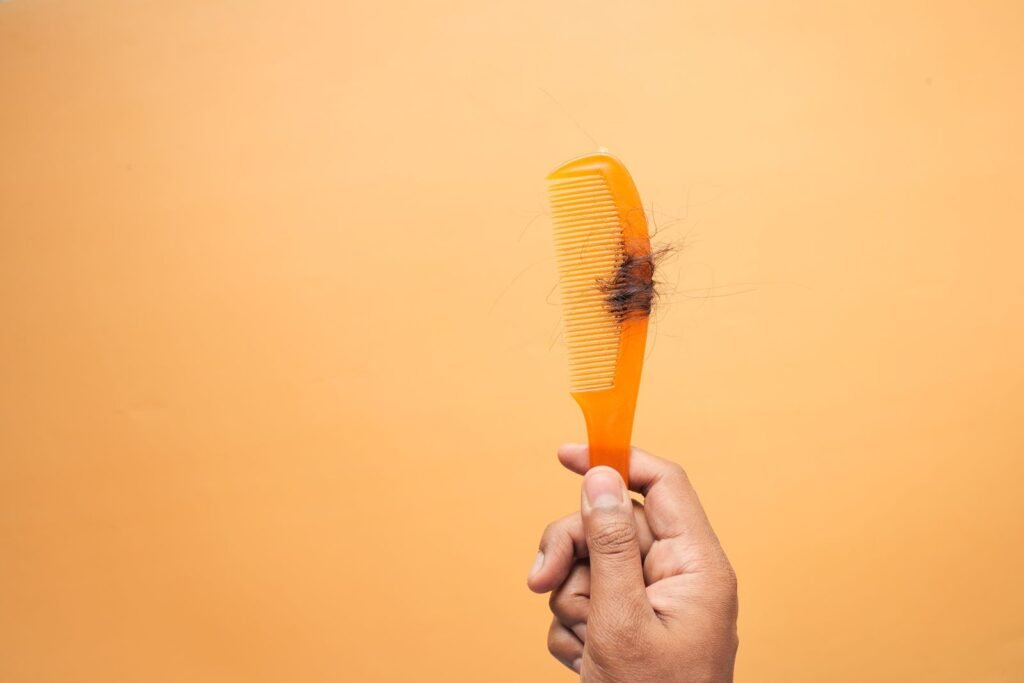
Short answer: there’s no good evidence that creatine causes hair loss. The worry traces back to one small 2009 study that found a rise in DHT, the hormone behind male pattern baldness, but that study never looked at anyone’s hair. In 2025, the first trial to measure hair directly found no difference in DHT or hair between men taking creatine and men taking a placebo. If creatine hair loss is what’s holding you back, that’s where the evidence stands.
Where the creatine and hair loss worry started
In 2009, researchers in South Africa gave 20 college rugby players creatine or a placebo for three weeks, then swapped the groups after a washout so each player tried both. On creatine, they loaded with 25 g a day for a week, then took 5 g a day for two weeks.
Testosterone didn’t change. DHT, however, rose by 56% after the loading week and was still 40% above baseline after two weeks at the lower dose. Because DHT drives male pattern hair loss in men who are genetically prone to it, the finding spread quickly through gyms and forums.
The study had clear limits. It involved 20 men, lasted three weeks, used a loading dose many people skip, and didn’t measure hair at all. The authors themselves also called for more research. It raised a question; it didn’t answer one.
What the 2025 creatine and hair loss trial found
The question sat open for 16 years. Then in 2025, a randomised controlled trial in the Journal of the International Society of Sports Nutrition tested it directly. Forty-five resistance-trained men aged 18 to 40 took either 5 g of creatine monohydrate a day or a placebo for 12 weeks, and 38 finished the study.
The researchers measured total testosterone, free testosterone and DHT. They also assessed the hair itself, including hair density, follicle counts and hair thickness, using standard hair-analysis tools. However, there were no differences between the creatine and placebo groups in DHT, in the ratio of DHT to testosterone, or in any hair measure. The authors concluded that their results provide strong evidence against the claim that creatine contributes to hair loss.
What creatine does in the body
Creatine is one of the most studied supplements in sport. Taking it raises the amount of creatine stored in your muscles, which helps with short, high-intensity efforts such as heavy sets and sprints. Over weeks of training, that extra capacity adds up to better strength and more lean mass. None of that works through DHT, which is part of why the hair loss link never fitted neatly with how creatine works.
Why the DHT theory of creatine hair loss doesn’t hold up
- Baldness depends on sensitive follicles, not just DHT. Male pattern hair loss happens when genetically sensitive follicles shrink under DHT over many years. So a short-term shift in blood DHT isn’t the same thing.
- The 2009 rise didn’t repeat. The larger and longer 2025 trial, using the everyday dose of 5 g, found no change in DHT.
- Expert reviews agree. A 2021 review of common creatine misconceptions, written by researchers who have studied it for decades, addressed hair loss directly and found no evidence that creatine causes baldness. The International Society of Sports Nutrition describes creatine as safe and well tolerated in healthy people.

If you’re already experiencing hair loss
If your hairline is receding, creatine is very unlikely to be the reason, and stopping it is unlikely to save much hair. Instead, genes and DHT sensitivity set the pace. The treatments with good evidence are finasteride and minoxidil (see finasteride vs minoxidil, and what DHT is for the hormone side).
If you’d still rather be cautious, skip the loading phase. It isn’t required, because a steady 3 to 5 g a day reaches the same muscle stores, just more slowly. That also avoids the high doses used in the 2009 study.
For choosing a product and dosing sensibly, see how to choose creatine and creatine for men over 40. For how DHT and testosterone fit together, see our complete guide to testosterone.
The other creatine myths
Hair loss is one of several worries that follow creatine around. The same 2021 review also looked at whether creatine causes water retention, kidney damage, dehydration and cramping, or counts as an anabolic steroid, and found the evidence doesn’t support those fears in healthy people at recommended doses. The one change most men do notice is a little extra weight on the scale early on, mostly water held inside the muscle (see creatine and weight gain). If you have kidney disease or take medicines that affect the kidneys, check with your doctor before starting.
Quick answers
Does creatine increase DHT?
One small 2009 study found a rise after a high-dose loading phase. A larger 12-week trial in 2025, using 5 g a day, found no change in DHT or in the DHT-to-testosterone ratio.
Should I stop creatine if I’m losing hair?
There’s no evidence that stopping creatine protects your hair. If hair loss worries you, talk to a doctor or dermatologist about treatments that target it.
This article is for informational purposes only and does not constitute medical advice. Consult a qualified healthcare professional before starting supplements or hair loss treatment.
Sources
- van der Merwe J et al. Three weeks of creatine monohydrate supplementation affects dihydrotestosterone to testosterone ratio in college-aged rugby players. Clin J Sport Med, 2009
- Lak M et al. Does creatine cause hair loss? A 12-week randomized controlled trial. J Int Soc Sports Nutr, 2025
- Antonio J et al. Common questions and misconceptions about creatine supplementation: what does the scientific evidence really show? J Int Soc Sports Nutr, 2021
- Kreider RB et al. International Society of Sports Nutrition position stand: safety and efficacy of creatine supplementation in exercise, sport, and medicine. J Int Soc Sports Nutr, 2017