
Of all the numbers you could track to gauge your health, one of the most powerful costs nothing and takes under a minute to test: how hard you can squeeze. It sounds almost too simple. But the link between grip strength and longevity has quietly become one of the most respected findings in medicine: in some studies, grip strength is a better predictor of how long you’ll live than blood pressure.
This isn’t about having a crushing handshake for its own sake. Grip strength is a proxy: a single, easily measured signal that reflects your whole-body strength, muscle health, and the resilience of multiple systems at once. This guide covers why it matters so much, what the research actually found, the benchmarks men should aim for, and how to test and build it.
Why a Hand Squeeze Predicts Grip Strength and Longevity
Here’s the key idea: grip strength doesn’t kill or save you directly. It’s a window into your overall health.
Because gripping hard relies on coordination across your muscles, nervous system, and cardiovascular system, your grip reflects far more than your forearms. It’s widely used as a stand-in for total body strength and muscle mass, and muscle is a metabolic organ that helps regulate blood sugar, inflammation, and hormone balance. When grip declines, it’s often an early flag for broader problems: muscle loss (sarcopenia), reduced neuromuscular function, and metabolic decline.
One researcher described grip strength memorably as “the sum of all health-related behaviours, activities, and illnesses both across a lifetime and in the recent past.” Unlike blood pressure or BMI (each of which captures one narrow slice of health), grip strength acts like an all-systems check. That’s why clinicians take it seriously.
What the Research Actually Shows
The evidence here is genuinely striking, and it comes from large, long-term studies.
- A 14,000-person study found grip strength to be a more accurate predictor of lifespan than blood pressure, one of medicine’s most traditional biomarkers.
- A meta-analysis of 42 studies found that people with low grip strength had a 67% higher risk of early death from all causes compared with those with high grip strength.
- Research has linked each meaningful drop in grip strength to higher mortality risk: one analysis associated each 5 kg decrease in grip strength with roughly a 16% higher risk of death from all causes and a 21% higher risk of cardiovascular death, independent of other factors.
- In older adults, grip strength predicts disability risk more accurately than age alone.
Crucially, these associations hold up even after accounting for age, weight, and physical activity. Grip strength isn’t just a stand-in for being young or being active: it carries independent predictive power.
Why such a strong link to the heart and longevity? Because grip strength reflects vascular health, autonomic nervous system function, and overall cardiorespiratory fitness, all of which feed into inflammation, insulin resistance, and cardiovascular stability. A weak grip is a dashboard warning light that the body may be under strain.
The Benchmarks Men Should Aim For
You don’t need a lab. Two simple tests give you a useful read.
The dynamometer test (the gold standard). A handgrip dynamometer is a cheap handheld device (around the price of a couple of takeaways) that gives a reading in pounds or kilograms. To test: sit with your arm at your side, elbow bent at 90 degrees, wrist neutral, and squeeze as hard as you can. Take the best of three attempts.
- Target for men aged 30-50: at least around 110 pounds (roughly 50 kg) on your dominant hand.
- Falling well below your age-and-sex norm is the signal worth acting on.
The dead hang test (no equipment needed). Hang from a pull-up bar with straight arms, feet off the ground, core engaged, no swinging, and hold.
- Goal: at least 60 seconds for an average adult.
- Elite target for men: around 2 minutes.
- Falling under 30 seconds is a major red flag for systemic upper-body weakness.
These aren’t vanity metrics: they’re quick, repeatable checks you can redo every few months to see whether you’re holding the line or slipping.
How to Improve Your Grip Strength
The good news mirrors the rest of men’s health: grip responds to training, and the fixes are the same fundamentals that build a durable body. Don’t bother squeezing a stress ball and calling it done: real gains come from loading your whole system.
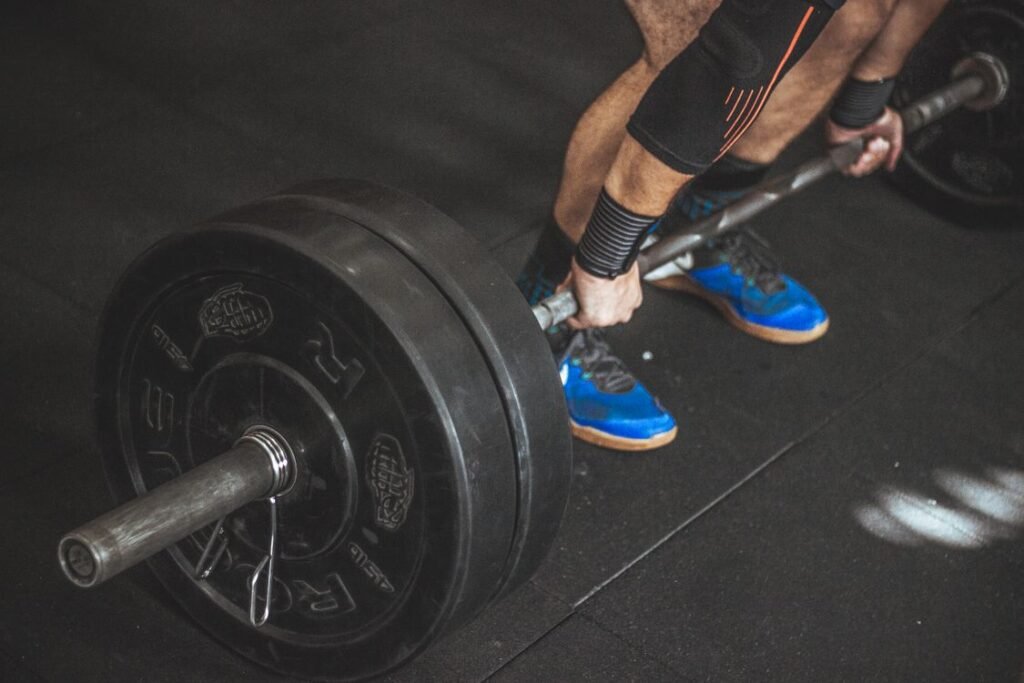
Lift weights, especially compound movements. The biggest driver of grip and total-body strength is resistance training. Prioritise compound lifts (deadlifts, rows, squats, presses, lunges) performed at least a couple of times a week. These build the upper-body and full-body strength your grip reflects.
Add loaded carries. Carrying heavy dumbbells or kettlebells (a “farmer’s carry”) forces your hands, wrists, and forearms to work under sustained tension, building exactly the real-world strength that keeps you capable. A solid goal: carry a meaningful load for 30 seconds without dropping it.
Train the hang. Practising dead hangs builds grip endurance directly and doubles as your test.
Use grip in daily life. Carrying the shopping, gardening, moving things: functional, grip-demanding activity counts.
Get enough protein. Muscle maintenance and growth need adequate protein: aim for a generous daily intake (in the region of 30 g or more per meal for most active men) alongside resistance training. This is especially important as you age.
Be consistent. Resistance training a couple of times a week, with progressive load over time, is the evidence-based recipe, not occasional bursts.
The underlying point: improving your grip isn’t really about your hands. It’s about building and keeping muscle, which is one of the highest-leverage things a man can do for long-term health.
A Note on Perspective
A weak grip doesn’t doom you, and a strong one isn’t a guarantee: these are correlations and signals, not verdicts. Grip strength is best understood as one easily checked clue in a bigger picture of healthy ageing, alongside other simple markers worth tracking: your VO2 max for aerobic fitness, your resting heart rate for cardiovascular health, and your heart rate variability for how well you’re recovering. Each captures a different system, and together they give a far more complete read on your health than any one of them alone. Grip strength’s value is that it’s simple, cheap, and trackable: a low-effort way to keep an eye on whether your overall strength is heading the right way.
FAQ: Grip Strength and Longevity
Why does grip strength predict longevity? Because it’s a proxy for total-body muscle and strength, and reflects vascular, neuromuscular, and cardiorespiratory health all at once. Low grip strength signals broader strain on the body, which is why it correlates strongly with mortality risk.
What’s a good grip strength for a man? As a rough benchmark, men aged 30-50 should aim for at least around 110 pounds (about 50 kg) on the dominant hand using a dynamometer. For the no-equipment dead hang, at least 60 seconds is a solid target.
Can I really improve my grip strength? Yes. Resistance training (especially compound lifts and loaded carries) combined with adequate protein reliably builds grip and total-body strength. Consistency over months is what matters.
Does squeezing a stress ball help? Minimally. Grip strength reflects whole-body strength, so the real gains come from resistance training and loaded carries, not isolated hand-squeezing.
Is grip strength a better predictor than blood pressure? In at least one large 14,000-person study, grip strength predicted lifespan more accurately than blood pressure. It’s considered a powerful, independent marker, though it’s one piece of the picture, not the whole story.
The Bottom Line on Grip Strength and Longevity
Grip strength is one of the most powerful, lowest-effort health signals available to men. The research is remarkable: it predicts lifespan better than blood pressure in some studies, and low grip strength is tied to a markedly higher risk of early death, even after accounting for age, weight, and activity. That’s because your grip is a proxy for your whole-body muscle and the health of multiple systems. Test yours with a dead hang (aim for 60 seconds) or a dynamometer (aim for ~110 lb if you’re 30-50), then build it the way you build everything that matters for longevity: lift weights, carry heavy things, eat enough protein, and stay consistent. It’s not about your handshake: it’s about how well you’ll move for the next forty years.
This article is for informational purposes only and does not constitute medical advice. Grip strength is a health indicator, not a diagnosis. Consult a qualified healthcare professional about your individual health and before starting a new exercise programme.
Sources
1. National Geographic, Why grip strength may be one of the best predictors of how long you live. 2. Confluent Health, Grip Strength: A Measure That Holds Onto Longevity (meta-analysis and 5 kg mortality data). 3. Men’s Journal, grip strength tests every man should pass (benchmarks). 4. Men’s Fitness, the fitness test linked to a longer life (14,000-person study). 5. Ubie Health, Grip Strength as a Longevity Predictor.
