
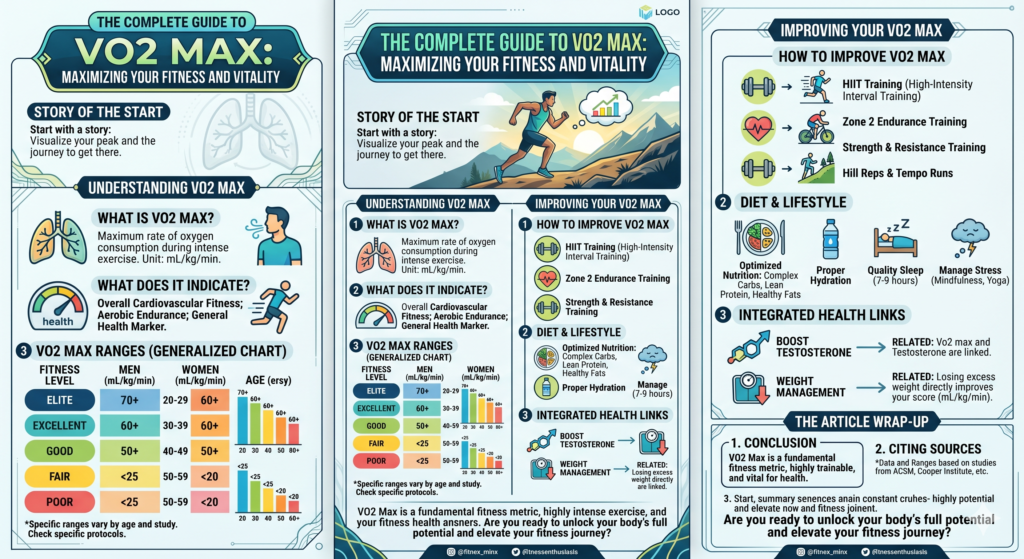
Learn what is VO2 max, see the complete VO2 max chart by age and gender, and discover proven training, diet, and lifestyle strategies to improve yours.
The Number That Caught Me Off Guard
The first time Adeel checked his VO2 max, he was sitting in his car after a morning run, slightly out of breath, scrolling through his smartwatch. He had been running three times a week for almost a year. He felt fitter. His clothes fit better. He could climb four flights of stairs without his lungs filing a formal complaint.
Then he saw the number: 38.
He frowned. He didn’t really know what 38 meant. Was that good? Bad? Average? Was his watch judging him? A quick search told him that for a 35-year-old man, 38 ml/kg/min was hovering near the lower end of “average,” barely above the threshold where doctors start raising eyebrows. For someone who ran regularly, that felt like a slap.
What Adeel didn’t know (and what most fitness enthusiasts don’t fully appreciate) is that this single number is one of the most powerful predictors of how long you’ll live, how hard you can train, and how well your heart, lungs, and muscles talk to each other. It’s also one of the most trainable metrics in your entire body.
This guide breaks down exactly what VO2 max is, what your number means, and how to push it higher with the right mix of training, nutrition, and lifestyle.
What Is VO2 Max?
VO2 max stands for maximal oxygen consumption: the highest amount of oxygen your body can take in, transport, and use during all-out exercise. It’s measured in milliliters of oxygen per kilogram of body weight per minute (ml/kg/min).
Think of it as your body’s aerobic horsepower. When you breathe, your lungs absorb oxygen and pass it to red blood cells, which deliver it to your muscles, where it’s used to generate ATP, the fuel cells run on. The more oxygen you can move and use, the more work your body can do before fatigue catches up.
VO2 max is widely considered the gold standard for measuring cardiorespiratory fitness. In 2016, the American Heart Association recommended that cardiorespiratory fitness (quantified by VO2 max) be assessed and used as a clinical vital sign, alongside blood pressure and heart rate.
What VO2 Max Indicates
A high VO2 max tells you several things at once:
- Your heart is strong and pumps a large volume of blood per beat (high stroke volume).
- Your lungs efficiently transfer oxygen into your bloodstream.
- Your blood carries oxygen well (good hemoglobin levels and capillary density).
- Your muscles extract and use oxygen efficiently: thanks to mitochondrial density.
It’s also a serious predictor of how long you’ll live. A 2018 JAMA Network Open study of more than 122,000 people at the Cleveland Clinic found that those in the lowest fitness group had a mortality risk roughly five times higher than the elite group, a gap comparable to the risk of smoking or diabetes.
A more recent 2022 meta-analysis in the British Journal of Sports Medicine showed that every 1 ml/kg/min improvement in VO2 max corresponds to a 2 to 3 percent drop in all-cause mortality risk.
Translation: even small gains matter.
VO2 Max Chart by Age: Where Do You Stand?
There’s no single “good” VO2 max. Your number has to be read against your age and sex. The tables below are based on the American College of Sports Medicine (ACSM) classifications, the same standard used in clinical and sports-science settings.
VO2 Max Chart by Age for Men (ml/kg/min)
| Rating | 18 to 25 | 26 to 35 | 36 to 45 | 46 to 55 | 56 to 65 | 65+ |
|---|---|---|---|---|---|---|
| Excellent | >60 | >56 | >51 | >45 | >41 | >37 |
| Good | 52 to 60 | 49 to 56 | 43 to 51 | 39 to 45 | 36 to 41 | 33 to 37 |
| Above average | 47 to 51 | 43 to 48 | 39 to 42 | 36 to 38 | 32 to 35 | 29 to 32 |
| Average | 42 to 46 | 40 to 42 | 35 to 38 | 32 to 35 | 30 to 31 | 26 to 28 |
| Below average | 37 to 41 | 35 to 39 | 31 to 34 | 29 to 31 | 26 to 29 | 22 to 25 |
| Poor | 30 to 36 | 30 to 34 | 26 to 30 | 25 to 28 | 22 to 25 | 20 to 21 |
| Very poor | <30 | <30 | <26 | <25 | <22 | <20 |
VO2 Max Chart by Age for Women (ml/kg/min)
| Rating | 18 to 25 | 26 to 35 | 36 to 45 | 46 to 55 | 56 to 65 | 65+ |
|---|---|---|---|---|---|---|
| Excellent | >56 | >52 | >45 | >40 | >37 | >32 |
| Good | 47 to 56 | 45 to 52 | 38 to 45 | 34 to 40 | 32 to 37 | 28 to 32 |
| Above average | 42 to 46 | 39 to 44 | 34 to 37 | 31 to 33 | 28 to 31 | 25 to 27 |
| Average | 38 to 41 | 35 to 38 | 31 to 33 | 28 to 30 | 25 to 27 | 22 to 24 |
| Below average | 33 to 37 | 31 to 34 | 27 to 30 | 25 to 27 | 22 to 24 | 19 to 21 |
| Poor | 28 to 32 | 26 to 30 | 22 to 26 | 20 to 24 | 18 to 21 | 17 to 18 |
| Very poor | <28 | <26 | <22 | <20 | <18 | <17 |
Source: ACSM Guidelines for Exercise Testing and Prescription, 10th edition.
A few important notes on the chart:
- Women’s VO2 max values are typically 10 to 15 percent lower than men’s of the same age, primarily due to differences in hemoglobin concentration, body composition, and heart size. This is physiology, not lower fitness.
- A sedentary man typically scores between 30 and 35 ml/kg/min, while elite marathon runners often reach around 70 ml/kg/min.
- VO2 max naturally declines roughly 5 to 10 percent per decade after age 30. Consistent training can cut that decline roughly in half.

How to Improve Your VO2 Max
Here’s the good news: VO2 max is one of the most trainable fitness metrics. Beginners can see meaningful gains in 6 to 8 weeks, and most people can expect a 15 to 25 percent improvement over six months of structured training.
1. High-Intensity Interval Training (HIIT)
HIIT is the single most effective tool for raising VO2 max. Research has consistently shown HIIT produces greater VO2 max improvements than steady-state endurance work in healthy young to middle-aged adults.
A few proven protocols:
- 4×4 Norwegian intervals: 4 minutes at 90 to 95% max heart rate, followed by 3 minutes of easy recovery, repeated four times.
- Tabata-style: 20 seconds all-out, 10 seconds rest, repeated 8 times.
- 30/30 intervals: 30 seconds hard effort, 30 seconds easy jog, repeated 12 to 20 times. Excellent entry point for amateur runners.
- Hill repeats: 2 to 3 minute hard hill efforts with easy jog-down recovery.
Aim for 2 HIIT sessions per week; push past that and recovery becomes the bottleneck.
2. Zone 2 Endurance Training
Don’t ignore the slow stuff. Long, easy aerobic sessions build the cardiac stroke volume and mitochondrial base that HIIT then sharpens. Spend 70 to 80 percent of your weekly cardio in Zone 2, a pace where you can hold a conversation but not sing.
3. Threshold Work
Tempo runs at 80 to 90 percent of max heart rate train your body to clear lactate more efficiently, raising the ceiling at which your VO2 max sits.
4. Strength Training
Stronger legs mean a more economical stride and better oxygen utilization at submaximal paces. Two strength sessions per week, focused on compound lifts (squats, deadlifts, lunges, presses), pair well with cardio without interfering with recovery.

Diet and Nutrition for a Higher VO2 Max
Training breaks the body down. Nutrition is what builds it back stronger.
Prioritize Complex Carbohydrates
Carbs are the primary fuel for high-intensity work. Eating around 50 grams of carbohydrates roughly 2 hours before a HIIT session (something like oatmeal with fruit) supports performance and recovery. Whole grains, oats, brown rice, sweet potatoes, and fruits should be the foundation.
Get Enough Protein
Protein supports muscle repair and the cardiac adaptations that drive VO2 max higher. Aim for 1.4 to 2.0 grams per kilogram of body weight if you’re training hard.
Watch Your Iron
Even subclinical iron deficiency (low ferritin without full-blown anemia) can suppress VO2 max by 5 to 10 percent. If you’re vegetarian, female, or training heavy mileage, get your ferritin checked.
Anti-Inflammatory Foods
Berries, leafy greens, fatty fish (salmon, mackerel), nuts, olive oil, and turmeric all support faster recovery between hard sessions. A Mediterranean-style approach lines up almost perfectly with what an aerobic athlete needs.
Beetroot Juice
One of the few supplements with real, repeatable evidence. The dietary nitrates improve exercise economy, meaning your body uses less oxygen at the same workload, which effectively raises your usable VO2 max in real-world performance.
Hydration
Even 2 percent dehydration can meaningfully drop performance. Drink throughout the day, not just around workouts.
VO2 Max and Testosterone: The Connection Most Men Miss
Here’s where things get interesting for men focused on overall vitality. VO2 max and testosterone are not independent variables: they actively reinforce each other.
A study from the Odense Androgen Study of 780 young men found that total and free testosterone were both positively associated with VO2 max, while body fat percentage showed a strong negative correlation (r=-0.63). In plain English: lean men with healthy testosterone consistently posted higher VO2 max numbers.
The reverse is also true: high-intensity exercise triggers testosterone production. Researchers tracking runners on a treadmill found that testosterone levels began rising once exercise intensity hit 90 percent of VO2 max and stayed elevated at 100 percent VO2 max, returning to baseline about an hour post-exercise.
What this means practically:
- HIIT sessions that push you near your VO2 max ceiling do double duty: they build aerobic capacity and trigger hormonal adaptations.
- Low testosterone is associated with lower aerobic performance, especially in older men.
- Improving one tends to improve the other.
If you want to dig deeper into the hormonal side of this loop, see our guide on How to Increase Testosterone Naturally, which covers the lifestyle, training, and dietary levers that move T levels in the right direction.
Weight Management: The Hidden Lever on VO2 Max
Because VO2 max is expressed per kilogram of body weight, body composition has an outsized effect on your number.
Drop fat mass while preserving muscle, and your VO2 max goes up almost mechanically: same engine, lighter chassis. Weight loss can directly increase VO2 max because fat mass is inversely proportional to relative VO2 max, meaning the focus should be on body composition rather than just the scale.
A few principles that work:
- Don’t crash diet. Severe calorie restriction kills training quality and stalls VO2 max gains.
- Eat at maintenance or a small deficit while training hard.
- Strength train to protect lean mass during fat loss.
- Track waist circumference, not just weight: visceral fat is the metabolic troublemaker.
For a complete framework on managing body composition without sabotaging performance, read our deep dive on Weight Management for Better Health and Fitness.
Lifestyle Factors That Quietly Move the Needle
- Sleep: 7 to 9 hours. Cardiac and mitochondrial adaptations happen during deep sleep, not during your workouts.
- Stress management: Chronic stress elevates cortisol, which suppresses both testosterone and recovery. Daily walks, breathwork, and prayer or meditation all help.
- Don’t smoke: Smoking destroys lung function and crashes VO2 max in measurable ways.
- Limit alcohol: It impairs sleep, recovery, and cardiac function.
- Altitude exposure: If you have access, training at moderate altitude can boost red blood cell production and oxygen-carrying capacity.
VO2 max doesn’t sit in isolation. It’s most useful when you read it alongside other markers of cardiovascular and physical health. Your resting heart rate reflects how efficiently your heart works at rest, and aerobic fitness is the single biggest lever to lower it. Your heart rate variability captures how well your nervous system is recovering between efforts, and it tends to improve in step with VO2 max. And grip strength (one of the most researched predictors of lifespan) rounds out the picture by reflecting whole-body muscle and structural health. Together, these four numbers give a practical dashboard for long-term men’s health.
Conclusion
VO2 max isn’t just a number on a smartwatch: it’s a window into how well your heart, lungs, blood, and muscles are working together. It predicts your endurance, your recovery, your hormonal health, and quietly, your odds of being around for the next few decades in good shape.
The encouraging part is that almost everyone, at almost any age, can move their number meaningfully with the right combination of HIIT, easy aerobic miles, smart eating, and consistent recovery. Pair that with attention to body composition and hormonal health, and the gains compound.
So the question to ask yourself is this: if your VO2 max is one of the strongest predictors of how long and how well you’ll live, what are you going to do this week to start raising it?
Sources
- Harvard Health Publishing, VO2 max: What is it and how can you improve it?
- Cleveland Clinic, VO2 Max: How To Measure and Improve It.
- American Heart Association, Scientific statement on cardiorespiratory fitness as a clinical vital sign (2016).
- American College of Sports Medicine, Guidelines for Exercise Testing and Prescription, 10th ed.
- British Journal of Sports Medicine, 2022 meta-analysis on VO2 max and mortality.
- JAMA Network Open, 2018 Cleveland Clinic cardiorespiratory fitness and mortality study.
- Endocrine Abstracts, Body composition and testosterone determined VO2max in 780 young men: Odense Androgen Study.
- Kodama S et al. Cardiorespiratory fitness as a quantitative predictor of all-cause mortality and cardiovascular events in healthy men and women: a meta-analysis. JAMA, 2009
- Milanović Z et al. Effectiveness of High-Intensity Interval Training (HIT) and Continuous Endurance Training for VO2max Improvements: A Systematic Review and Meta-Analysis of Controlled Trials. Sports Med, 2015
- Kaminsky LA et al. Reference Standards for Cardiorespiratory Fitness Measured With Cardiopulmonary Exercise Testing: Data From the Fitness Registry and the Importance of Exercise National Database. Mayo Clin Proc, 2015